
• Skip to primary navigation
  • Skip to main content
  • Skip to primary sidebar
Gita Wisdom - Teachings for the Modern Day Yogi
  • About
    • About Gita Wisdom
    • The Bhagavad Gita
    • The Gita Wisdom Staff
  • Prabhupada
    • Srila Prabhupada’s Books
    • Rock On, With Care
  • Watch
  • Listen
    • Podcasts
    • Interviews
  • Read
    • Books
      • Non-Fiction
      • Fiction
      • Children’s Books
    • Editorials
  • Topics
    • Art
    • Environment
    • Gita Verses
    • War and Peace
    • Workplace
    • Yoga
  • Extras
    • Quiz Questions
    • Vocabulary
  • Connect

Gita Wisdom

March 21, 2020 by Gita Wisdom

The Search for an Art of Transcendence

Estimated reading time: 16 minutes

A young man pursues the meaning of creative expression

I came of age in the mid-Sixties and attended expensive schools on scholarships. That put me in a socially awkward position and I ended up spending a number of weekends on my own wandering through New York City’s cavernous museums. New York’s museums offered an unparalleled perspective on the history of art. In one afternoon, a visitor could journey on foot from prehistoric cave paintings to Renaissance pietas, and from there to pop art, op art, and the latest in Sixties psychedelia.

My favorite museums were the Metropolitan, the Guggenheim, the Museum of Modern Art, and also the Museum of Natural History where I was struck by the apparent parallel between the evolution of art and the evolution of man. First came the cavemen, with their cave paintings rough, simplistic products of an obviously lower order of intelligence. Then, as man began wearing clothes, shaping tools, and tilling the earth, he produced the crude religious paintings and iconography of early civilization. Finally, as man grew more civilized, art grew more sophisticated, until homo sapien was producing an artistic legacy as complex and unfathomable as his own neurological organs.

The apparent parallel evolution of art and man was too pat; it left an empty feeling in my stomach. Though my education taught me to accept such a parallel, some part of me disagreed with the premise that art viewed chronologically was synonymous with art viewed progressively. The free-floating Calder mobiles appealed to my sense of aesthetics, but did that place them somehow above the simpler works relegated to sections marked “Tribal Talismans”? The sensual curves of a Moore sculpture attracted my adolescent mind, but were they “better” than the three-thousand-year-old works designated “Hindu Deities”? The open-ended canvases of Jasper Johns made me think about how his work affected me, but did I feel any less affected by the delicate miniature encrusted with gold and labeled “Krishna: Indian Forest God”?

Reclining Figure (1982), Henry Moore – Kunst in Schwäbisch Hall
By Chandravathanaa – Own work, CC BY-SA 4.0

These exhibits were consistently arranged to suggest that objects of art were no more than cultural artifacts. The arrangement was no doubt the work of anthropologists, art historians, sociologists, and others who had a vested interest in making culture central and human history a chronological journey forward. Religious art with its references to gods and goddesses might be esthetically pleasing, but it was the vestige of a less evolved time in humanity’s past. It was art as an expression of life’s grounding in physicalist reality that had something useful to offer. 

By the time I met devotees of Krishna in Paris in 1969, I’d been indoctrinated into this idea that art could change the world provided it did not depend on a theistic structure to creation. I’d attended courses with titles such as “Existentialism and Modern Art,” “Physics for Poets,” “Social Trends in Art History,” and “Picasso and the Collective Unconscious.” What these courses all had in common was an insistence on the interrelationship of the arts and the notion that art should judiciously avoid otherworldliness. Like the perfectly ordered historical art exhibits I had known during my high-school days, my university also treated art as one of the Humanities, as a subject that dealt exclusively with human meanings. Art, these courses insisted, can be understood only within the context of culture.

Krishna devotees lived with art that went beyond this notion. In those early days of the Krishna consciousness movement in France, readings from the Bhagavad-gita and group chanting of Hare Krishna took place on Sundays in the Latin Quarter, at a gray two-story hangout for students, artists, poets, and musicians. Perched precariously on a folding chair in the corner of a room that sat about thirty was a three-foot-high color poster of Gopala (Krishna), the Supreme Lord and the speaker of the Gita. The name Gopala means “cowherd boy,” and in the picture Gopala was sitting gracefully, with His arm around a calf, looking off into the distance.

“Who’s that in the picture?” I asked a devotee named Umpati who stood peeling apples by the door.

“That’s Krishna, the Supreme Personality of Godhead.”

“And the cows and trees—is that supposed to be heaven?”

“No, not heaven. That’s still within the material world. The spiritual world is different.”

I watched the devotee meticulously arrange the apple sections on a brass tray, then he placed the tray on before the poster on the folding chair and murmured prayers. A few moments later, he sat on a cushion before the group that had assembled for the class and began reading in French from the Bhagavad-gita. 

“Krishna’s body,” he explained, “is not limited by material elements, as is our body. His body is not subject to laws of decay and death. And since He is absolute, He remains spiritual in all His manifestations. His appearance in wood or stone or paint transforms the material medium into His own spiritual substance. We should not think that a Deity or painting of Krishna is an idol. It is Krishna Himself, graciously appearing in a form visible to us, to help us remember Him.”

Unexpectedly, I was hearing a challenge to my long-held belief in the cultural relativity of art. Extrapolating freely, the Bhagavad-gita had this to say about art. Art can contain more than human elements. Under certain conditions a work of art can serve as a vehicle for higher, transcendental forces, whose impact on the viewer or hearer (in the case of music, drama, or poetry) will not depend on social or intellectual history. The mere act of seeing such art can produce a spiritually uplifting effect. Though intellectual awareness of the history of the image may enhance appreciation, such awareness is not prerequisite to its spiritual impact. According to the bhakti or Krishna tradition, an artistic representation of divinity is not different from divinity and can act on observers regardless of the art’s cultural significance.
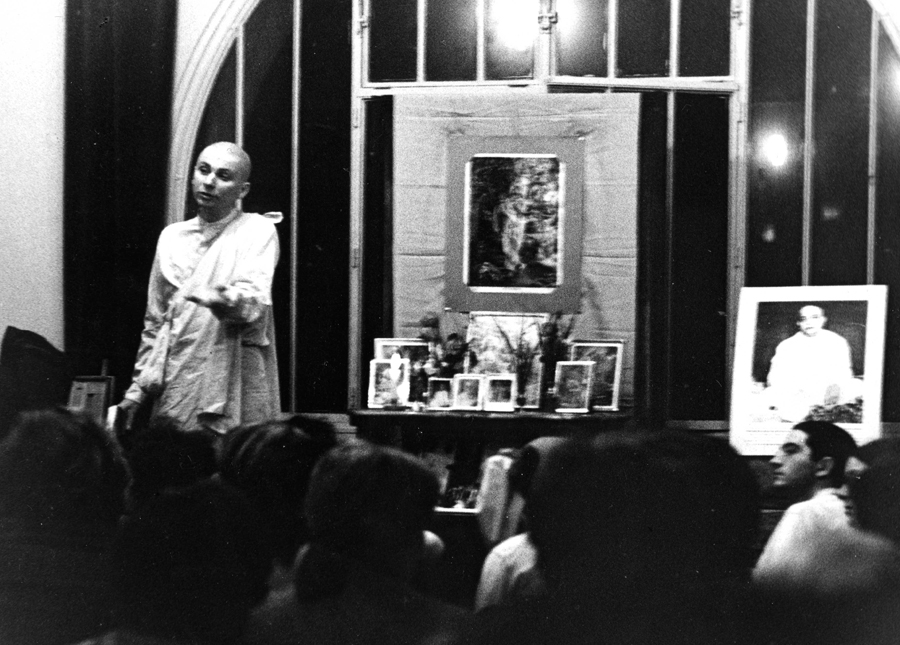
1969, Umpati gives a Bhagavad Gita class at the American Center in Paris

I began spending evenings with devotees in their small apartment, which they had decorated with posters and drawings of Krishna in His various incarnations and of sages from the scriptural histories. None of these works struck me as artistically astute. The features were often naive, the compositions unimaginative, the proportions out of whack. 

The greatest travesty, in my eyes, was that they failed to challenge the observer’s imagination. Little in any of these pictures left anything to the onlooker’s interpretive skills. They were purely representational; the spectator did not participate. There was Krishna tending His cows in His village, called Vrindavan, and there were the trees and flowers, all neatly arranged, best blossoms forward. It was clear that the artists had done their job quite well by painting what was described in scripture—but now the painting was there, and now the observer had only to gaze.

The devotees described their experience differently. Seeing Krishna in art, they explained, was for them like looking through windows onto the spiritual world. Each morning they would sit for an hour or more, concentrating on the paintings as they chanted Hare Krishna on wooden beads. Cultural significance had nothing to do with these contemplative moments. The devotees sat entranced before these paintings, which permitted them to commune with Krishna, and for the devotees that was all that mattered.

Many months later Srila Prabhupada, the founder and spiritual guide of the Krishna consciousness movement, visited Paris. By that time I had myself become a devotee of Krishna, and Srila Prabhupada’s visit seemed a good opportunity to clear up some of my lingering questions about the role of art in spiritual life. I waited until I could meet with him in his quarters, and then I dove right in.

“What is the function of art for devotees, Srila Prabhupada?” 

He looked up and studied my face for what seemed a long time, then said, “It is to put things in their proper place for best utility.”

I didn’t understand what he meant, but rather than ask the same question again, I said, “Some artists might disagree. Sometimes it is considered art to take an object out of its proper place and give it a life of its own. Some artists argue that a work of art is a reality in itself and that art doesn’t depend for its value on anything or anyone else. They say that art is most beautiful when accepted as a self-sufficient reality.”

“Beauty and art are different,” he corrected. “Beauty is something that satisfies my eyes. Your eyes may be satisfied by something, my eyes by something else. According to your idea of beauty, my beauty may be unacceptable. Beauty is a kind of sense gratification.”

“Some paintings are not trying to be beautiful,” I said. “They’re trying to make a statement about the world and our place in it.”

“That’s alright,” he said, “but you asked about beautiful. There is no such thing as a standard of beauty. Just like nowadays artists make ‘beautiful’ paintings,” and he waved an imaginary paintbrush wildly in the air above his head and laughed. 

“I don’t like it, but someone else may say it is very beautiful. So beauty and art are different. And for devotees art means arranging things for the highest utility. Beauty may satisfy but not have any higher utility. A picture, a poem anything is art when it serves the very best utility.”

Utility was obviously the crux of his definition of devotional art. “If someone’s work fulfills that qualification of highest utility, is he an artist?”

“Yes. An artist is one who knows the standard of best utility.”

I opened Webster’s. “One definition for artist in the dictionary is ‘one specifically skilled in the practice of a manual art or occupation, as cooking.’ So applying this to your interpretation, a cook preparing food for Krishna is an artist.”

“Oh, yes, anyone who performs his work for the satisfaction of Krishna, who knows His relationship with Krishna, is a true artist.”

That helped clarify his use of the word utility. He was defining art as any work that brings the performer out of the cycle of birth and death and closer to God. He was defining art as yoga. By this Prabhupada was not denying the need for rules of composition or balance in color and design. Rather, he was expanding the meaning of art beyond the traditional forms of painting, sculpture, music, drama, poetry, to include every field of human endeavor–a notion described in Bhagavad-gita (2.50):

Persons engaged in devotional service free themselves of both good and bad actions even in this life. Therefore, strive for yoga, which is the art of all work.

In the simple acts of devotion I’d witnessed in my first encounter with devotees—the offering of sliced apple on a tray before a poster of Krishna—there was artistry at work I could not appreciate at the time. Inspiration is communicated by the art of work as effectively as by a work of art. In simplest terms, Krishna in the Gita exhorts everyone to become an artist by performing their work as an offering of love to Him.

“In other words,” I asked, “would we say that anyone who works on behalf of Krishna, according to Krishna’s direction, is an artist?”

“Yes. A devotee knows the standard of utility. He knows how to put things in their proper place to inspire love for Krishna in himself and others.”

Srila Prabhupada stopped speaking, and a thoughtful silence filled the room. I thought back to my first days after Paris, as a devotee in the London Krishna temple, where I met a young Scottish devotee named Digvijaya. He was the temple’s cook. No one knew how to “put things in their proper place” better than Digvijaya. A simple country boy with a knack for detail, Digvijaya could turn a tray of raw vegetables into a royal feast and kept an immaculate kitchen that boasted rows of pots sparkling from the hours of patient scrubbing he had put into them. Attracted by his fastidious habits and culinary feats, I would sometimes go down to the basement work area and help him prepare an offering for the Deities.

“You like to work for Krishna in the kitchen, don’t you?” I asked him one evening. 

Digvijaya looked a little flustered and went on with his cooking. Finally, he looked up and said, “Actually, I don’t consider myself advanced enough spiritually to serve Krishna directly. I’m happy just cooking for His devotees.”

This was a young man whose culinary skills could have earned him a place in fine restaurants, yet he was humble, and during our talk he revealed to me the secret of spiritual cooking.

“Don’t speculate,” he said. “The best recipes for Krishna prasadam, vegetarian dishes for Krishna’s pleasure, have been around for a long time. A good devotee chef cooks them just as Krishna has always liked them, since time immemorial.”

Now, two years later, Srila Prabhupada was confirming the same principle as the essence of spiritual art. Don’t speculate. Your work is meant to be an offering of love for Krishna, not a product of artistic ego. Let Krishna guide your efforts.

“Real art, then,” I said, “means simply to do something for Krishna’s pleasure?”

“Yes,” Srila Prabhupada replied. “That is also the definition of love: to do something for the pleasure of the beloved.”

“But what about artists as a class of people? What about art as a specific field of creative endeavor, art in the classical sense painting, sculpture, music? Do spontaneity and personal inspiration play no part in Vaisnava [devotional] art? Is the artist irrelevant if everything he does is already laid out in the scriptures?”

“All these questions will be answered when you visit the artists who paint for my books.”

Many months later I had that opportunity. At the devotee artist studios (then in Los Angeles), much was like what I had seen in dozens of other studios: paintbrushes, canvases, some reference books. But there were new elements as well. Music played constantly in the background: devotional songs that set a mood for the work at hand. Sometimes two or even three artists at a time worked to complete a painting, each contributing his or her best effort, either in background design, facial details, jewelry, architecture. The artists, in their discussions, constantly referred to Vedic scripture. Clearly they had studied the history of their subjects well, and they drew details for the work from the ancient texts.
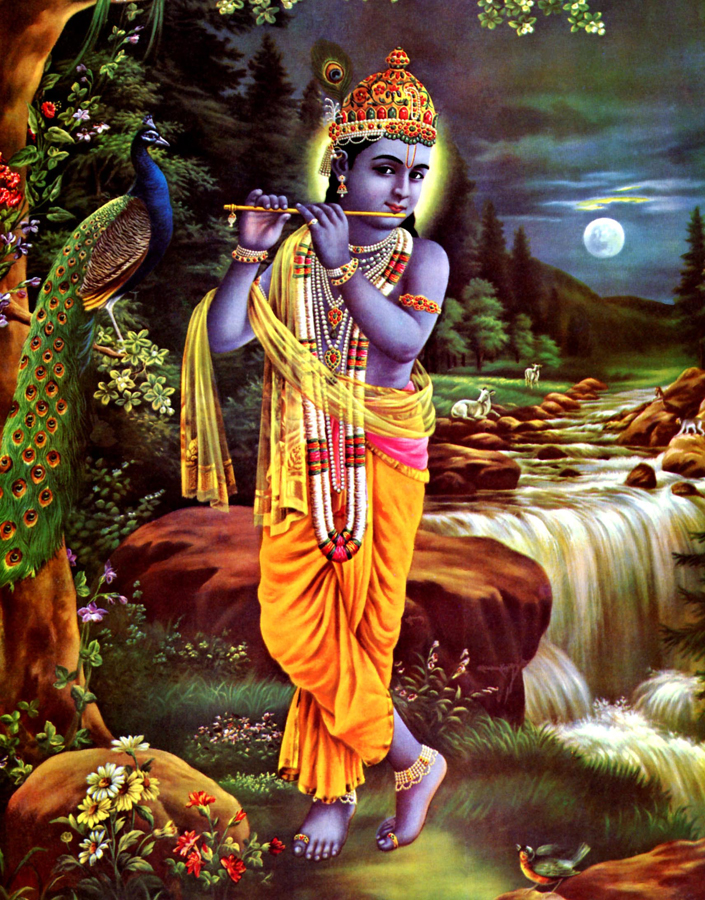
Krishna playing the flute

I asked one young man where he had received his training. He had graduated from a well-known art school, he said, and after becoming a devotee he had gone to India. What was an artist’s training like in India? “Oh, very intense,” he said. “An artist in the devotional tradition never attempts a sculpture or painting of Krishna unless his teacher has sanctioned both the work and his readiness to execute it. The forms of Krishna are divine; when depicted by one who is not in the proper devotional mood, the result can be unintentionally offensive.”

I noticed a young woman prepare her brushes by washing them in a sink down the hall. There was a bathroom closer by, but, she explained, through the agency of these brushes Krishna would appear on canvas, and so she preferred not to wash them in the bathroom. Before applying the first strokes to her canvas, she folded her hands and offered Sanskrit prayers before a picture of her spiritual master.

The artists were trained technicians in their craft. In the sculpture workshop a heavyset man with a clean-shaven head applied filler to a bust of Old Age, a character in a diorama depicting birth, death, and rebirth. He looked at the bust, and, for my benefit, broke down the visual impression into colors, contrasts, perspectives, relationships, planes, and other aspects that had escaped my untrained eyes.

Yet beyond technical prowess, the artists were depicting Krishna in minute details. They pointed them out to me: flowers leaning toward Krishna’s feet, birds observing Him from the branches of trees, in the rainclouds hovering in the distance, intentionally abstaining from disturbing Krishna’s playing with His friends. The artists described as well their appreciation for the very tools of their trade. Krishna was in the earth and clay that made up their paints. He was in the water that washed the brushes. He was the light of the sun that illuminated their studio. Nothing in their work was separate from Him, and by His presence the work itself became transformed into an act of meditation and prayer.

I asked several of the artists what they felt was the most important part of their work. Though one or two spoke of abstract concepts such as detachment from the finished product, they agreed that the most important part of their work was a strong daily program of morning sadhana, the devotional and meditative practices that begin around 4:30 a.m. and end by 8:30 a.m. in every temple of the Krishna consciousness movement. Without that regularity of spiritual discipline, they all agreed, they could never put brush to canvas or chisel to stone.

Over the course of the last few years, my deepening appreciation for spiritual art has cast in a different light the culturally based ideas of art that I grew up with. Instead of a progressive development in the arts, the contents of our museums seem to evince man’s increasing estrangement from his spiritual roots. The further we divorce ourselves from the notion of a higher being and a life beyond matter, the more abstract and cerebral and sterile our artistry grows. And what usually passes as spiritual is in fact merely a negation of what we take to be material: form, personality, recognizable elements of creation. As a result, the spiritual reality, a world filled with variety, form and personality remains hidden from our view. That spiritual reality, says the Bhagavad-gita, is revealed proportionately as we step away from the egoistic notion that “I am the creator” and “I am the artist” and step closer to acceptance of his role as an intermediary, a conduit for God’s artistry.

Even an untrained devotee artist can become such a medium. This is true because the transcendental quality of a work of art is a result not of technical skill but of the artist’s purity of devotion, his desire to glorify God through his work. Properly guided, even an unskilled devotee artist can bring out the Supreme Spirit for all to see, as exemplified by the following anecdote told to me by one of the artists in Los Angeles.

Once, while traveling by plane, Srila Prabhupada chanted Hare Krishna on his beads while meditating on a drawing of Krishna pinned to the back of the seat in front of Him. This is a common practice among devotees who travel, but it was striking that Srila Prabhupada had chosen this particular drawing to meditate upon. It was done in crayon: the unpretentious, untutored work of a child. It had little aesthetically redeeming value. To Srila Prabhupada it was finer than a Rembrandt, more meaningful than a Degas, more intriguing than a Picasso, because it was Krishna drawn by the loving hand of His young devotee. 

In that simple sketch was abundant subject matter for Srila Prabhupada’s artistic contemplation: devotion, sincerity, earnest labor, and a six-year-old’s humble offering of love to God.

Filed Under: Art

July 13, 2019 by Gita Wisdom

June 27, 2019 – LI Series, Week 34: A Rational Approach to Detachment Part 2

The discussion continues about the nature of an inner life and giving up attachments. BG 5.22-5.25

Stream


Subscribe

[iTunes] [Stitcher] [Hipcast] [Spotify]


Homework

For our next class please read [BG 5.26 – 5.29].


Mentioned in this podcast

Abbreviations used in these notes: BG for Bhagavad Gita

Books

  • Bhagavad Gita As It Is

Verses

BG 5.22 – BG 5.25

An intelligent person does not take part in the sources of misery, which are due to contact with the material senses. O son of Kuntī, such pleasures have a beginning and an end, and so the wise man does not delight in them.

Before giving up this present body, if one is able to tolerate the urges of the material senses and check the force of desire and anger, he is well situated and is happy in this world.

One whose happiness is within, who is active and rejoices within, and whose aim is inward is actually the perfect mystic. He is liberated in the Supreme, and ultimately he attains the Supreme.

Those who are beyond the dualities that arise from doubts, whose minds are engaged within, who are always busy working for the welfare of all living beings and who are free from all sins achieve liberation in the Supreme.

BG 2.59 –  Though the embodied soul may be restricted from sense enjoyment, the taste for sense objects remains. But, ceasing such engagements by experiencing a higher taste, he is fixed in consciousness.

Vocabulary

Anta – The end or the goal (Vedanta = the conclusion of the Vedas)

Buddha – Generally: one who possesses knowledge (buddhi), from the root budh: to awaken.

Dristva – A vision or perception, either visual or intuitive

Dukha – Mental or physical distress

Param – Superior, higher (sometimes highest: paramanu = sweet rice, the highest or best dessert)

Samsara – Cycle of birth and death

Sisya – Disciple. One who voluntarily submits to discipline in spiritual life

Sukha – Mental or physical comfort

Quiz

QUIZ START

Transcript

Running time: 33 minutes

Joshua: We’re in the fifth chapter now which is a little bit less than a third of the way through. Krishna and Arjuna were talking about three hours, two to three hours. We have no audio recordings from 5000 years ago, so we really don’t know how quickly they were speaking. We don’t know whether there were any silences, any pauses in between. 

Student: How do you know that it was that many hours? Is it documented somewhere? 

Joshua: I’ve timed it. 

Student: Didn’t you write in here that the whole conversation is like two hours? 

Joshua: It depends on how you parse it. If you just read straight through, you can read the verses of the Gita in two hours. It’s not hard. 

Student: Hey Yogi? Do you want to give a little thumbnail for…

Joshua: Of the setup of the Gita? Yeah, sure. Have you connected with the Bhagavad Gita? I know you’ve been here so you’ve heard a little bit about the Gita. 

Student: A little bit. 

Joshua: How about you? 

Student: No. 

Joshua: Alright. Of all of the wisdom texts of the faith traditions, particularly the East, Bhagavad Gita is considered the essential text. There are about 12 different kinds of yoga described in the Bhagavad Gita. 

Of those different forms of yoga, bhakti, or devotional yoga, is described as the goal, the highest form, because it’s the yoga of the heart. And the set up, very briefly, is it’s on the verge of a battle.

Every other possible means of avoiding conflict have been exhausted and the two sides are now poised to fight. And the hero of the Gita, who’s a heartfelt soldier named Arjuna, doesn’t want to kill. He’s just kind of confronting an existential crisis. His whole life has been in preparation for this moment, and he can’t do it. 

He can’t go out there and harm people. His heart’s too soft and he sees too many downsides to the battle. He knows he’s in trouble because he knows that these—we call them terrorists today—they have to be stopped. So he knows he has to fight. 

And so he approaches Krishna and says at the end of the first chapter, “sisyas te ‘ham sadhi mam tvam prapannam.” Sisya. Now I am your sisya. Now I am your disciple. When Madhava Puri and Anuradha received initiation two weekends back, they assumed the roles of sisya, disciples to their guru Radhanath Swami. There’s something similar taking place here on this battlefield where Krishna is acting as Guru to his sisya, his disciple, Arjuna. And it’s life lessons. It’s confronting the thing that you least wish to confront. Which is what yoga is really all about. Yoga is not about running away from problems. Yoga is about equipping yourself with the tools to more effectively manage the challenges of life. And that’s what’s happening here is that Arjuna is reinforced, his self-assurance is being brought back to the surface because Krishna is a very good teacher and knows how to bring him step by step back to that place of action from inaction by first of all reminding him (this is the second chapter) that you are different from the frail physical body, the perishable physical body. Consciousness is not the product of material forces. You, the essence, the atma, the self, the consciousness animating this body with life, you are of a different nature. You are not born of the material energy. You’re a divine creature. You are a divine, fully self-sufficient being, and your concern over the material consequences of what you are called upon to do here is understandable but misplaced. You can do more than you know. And in this instance if you don’t do it there would be severe repercussions. So he’s bringing Arjuna back to that place of self-confidence. What might be called healthy ego. 

There are two kinds of ego. There’s material ego which is me me me, and then there’s the eternal ego which is you you you. How can I be of service in this situation, in this moment? How can I serve this moment?

And so the goal of yoga practice is not the obliteration of ego, which is a mistaken idea. Some schools espouse that. That egos is to be dismantled and dissipated. You can’t do that. Ego means self. The self is indestructible. So the Gita is about replacing the frail dangerous ego with the healthy permanent ego of knowing oneself to be an eternal being. So that’s basically the Gita in a nutshell, more or less the rest is detail. 

The goal of yoga practice is not the obliteration of the ego. Ego means self which is indestructible. The Gita is about replacing the frail, dangerous ego with the healthy, permanent ego of knowing oneself to be an eternal being.

Click To Tweet

Krishna describes different concepts—how the world operates, how it came into being, how you take up different bodies—what we call reincarnation or samsara, Sanskrit, the structure of the universe. There are many different topics dealt with in this relatively brief timeframe, so it’s worth discussing because one verse contains enough information for a whole semester’s course. 

So we go through two or three verses maybe at a sitting and then we start by reciting the verse. There is a melody. There are different melodies for reciting these verses. So we’re in the 5th Chapter starting with verse 22.

Joshua: ye hi saṁsparśa-jā bhogā. You have here the original Sanskrit. What is it called? Devanagari. It almost looks like Hebrew. That original Sanskrit text in Sanskrit is called Devanagari, the language of the gods. Underneath it you have the transliteration. That’s how those words are pronounced. So the first line: 

ye hi saṁsparśa-jā bhogā
duḥkha-yonaya eva te 

Underneath are the synonyms for each word. That’s very helpful. For example, in this verse there are some words that are very worthwhile to know. Read through the synonyms, and you tell me what some of the words are that are beginning to sound familiar? What words have we come across before?

Student: dukha

Joshua: Dukha is an important word in Sanskrit. What is the meaning of Dukha? 

Students: Distress. 

Joshua: It means distress. It means the sadnesses, the miseries, the disappointments. 

Student: The yuckiness. 

Joshua: Yuckiness, yes. The yuckiness of embodied life in the material world. Do you know what the opposite word is? 

Students: Sukha.

Joshua: Yes. Sukha and dukha. What’s another word in this verse that you may be familiar with? 

Student: Buddhah. That’s at the end.

Joshua: Yes, very good. Buddha, meaning intellect, intelligence or an intelligent person. Ramate. In the Maha Mantra we have Hare Rama. So here the word appears as ramate—those who take delight, joy. They take their satisfaction in something. 

Here’s another word: yona, yoni also, which means womb, the source, the point of origination. So that’s another word that you’ll become familiar with. 

Antavantah. Anta meaning end. That’s a word that you’ll become familiar with as well as we read the verses.

So shall we try reciting this together?

ye hi saṁsparśa-jā bhogā
duḥkha-yonaya eva te
ādy-antavantaḥ kaunteya
na teṣu ramate budhaḥ

You get familiar with it after awhile. We’re not going to go into the diacritic marks, which are those little dots and dashes on top or below the words. We’ll do that some other time. Translation. Who has the book? Would you read the translation? 

Student: “An intelligent person does not take part in the sources of misery, which are due to contact with the material senses. O son of Kuntī, such pleasures have a beginning and an end, and so the wise man does not delight in them.”

Joshua: So there are a few points to be reviewed here. I want to quickly go through the other three verses that we assign for today’s discussion so that we put this in context. Would you mind just reading the translation to verse 23? 

Student: “Before giving up this present body, if one is able to tolerate the urges of the material senses and check the force of desire and anger, he is well situated and is happy in this world.”

Joshua: These are kind of complementary instructions. One is that the wise person does not take part in the dukha, the sources of misery which are described here as, “contact of the senses with sense objects.” Then in the 23rd verse, if you can tolerate those impulses of the senses—to engage with sense objects—you can be happy. Alright, we’re going to unpack this in a minute, but let’s just go through the 24th verse. Do you have a book there? Would you mind reading the translation to verse 24? 

Student: “One whose happiness is within, who is active and rejoices within, and whose aim is inward, is actually the perfect mystic. He is liberated in the Supreme, and ultimately he attains the Supreme.”

Joshua: And the last verse, verse 25. 

Student: “Those who are beyond the dualities that arise from doubts, whose minds are engaged within, who are always busy working for the welfare of all living beings, and who are free from all sins, achieve liberation in the Supreme.”

Joshua: OK, so there’s a thread running through these verses. How would you describe the thread? How would you describe the core concept that connects these verses together? 

Student: Well, maybe one concept would be that it’s sort of telling you how to focus on non-material distractions in order to maintain equipoise, stay equally thoughtful in all situations. 

Joshua: What’s an example of a material distraction? Let’s get specific here. 

Student: It specifically says limit contact with material senses. 

Joshua: Is that reasonable? Can we avoid the engagement of our material senses? How do you do that? Doesn’t sound very practical. 

Student: How do we avoid contact with material senses? Well, I don’t know if it’s avoidance as much as connection with something that’s not of the material senses. The way I’m reading it. 

Joshua: Take that a little bit further. What is of that other nature that is not of the nature of the material senses? 

Student: The Supreme. 

Joshua: Meaning?

Student: Krishna. God. 

Joshua: Okay. I want what my grandmother would call the tachlis. Tachlis means the goods. Give me the goods here, okay? I get lost in the verbiage. The Supreme and the senses. Let’s drill down on it. 

Student: More practical? 

Joshua: Yeah. What’s being said here? What’s the meaning of this? You’re all welcome to volunteer some ideas. There’s no right or wrong answer. What’s your impression? Does this say anything to you? 

Student: Well, to me, reading all these words it sounds like just going inward instead of concentrating on outwardly material things—cars, clothes, going to the bar. 

Joshua: And this is her first class here. She’s doing better than all you guys combined.

[laughter and crosstalk]

Alright. So that’s, shall we say, those would be the obvious examples. You know, acquisition gets a bum rap in yoga. But let’s go a little deeper here. What else is going on? Come on, you’ve got to have some insights into this. You’ve been around here long enough. Think of the context. What’s the context? 

Student: To stay focused and to not get caught up in everything that flies around us all the time. 

Joshua: OK. 

Student: Equanimity. 

Student: Equanimity, but not becoming attached to all the pleasures and pains that come and go. And then you’re happy, and then it’s easier to connect with the Krishna because you’re not so distracted with your wants all the time. 

Joshua: I’m throwing down the gauntlet. How can we, embodied beings, gorgeous creatures that we are, how do we avoid being involved? I mean, isn’t that what makes life worth living? 

Student: By engaging in devotional service. Chanting. 

Joshua: This is called, in English, the party line. 

[laughter]

Student: I’m going to ask a really controversial question. What’s wrong with moderating it? I have a problem with this whole black-and-white, good-bad thing. I understand that there are certain things—even murder is evil—and then this person is supposed to go to war, and there’s going to be someone who’s going to have to die. I just feel very conflicted. 

Joshua: Alright. If you come back next week, I’ll buy you dinner. This is what we need.

Student: Because I just had an entire conversation with someone about something very similar, but not from this book, about what’s considered a holy and an unholy pursuit in sexual desire. Everyone’s answer is going to be different based on the content. 

Joshua: Exactly right. Thank you. 

Student: Ah. I can breathe now.

[laughter]

Joshua: Yeah. There seems to be something awfully black and white, to use your phrase, about all this. Well, is it black and white? Or is there something that we might call mitigating, in let’s say, verse 24. Would you read 24 for us? 

Student: “One whose happiness is within, who is active and rejoices within, and whose aim is inward is actually the perfect mystic. He is liberated in the Supreme, and ultimately he attains the Supreme.”

Joshua: Would you read the purport?

Student: “Unless one is able to relish happiness from within, how can one retire from the external engagements meant for deriving superficial happiness? A liberated person enjoys happiness by factual experience. He can, therefore, sit silently at any place and enjoy the activities of life from within. Such a liberated person no longer desires external material happiness. This state is called brahma-bhūta, attaining which, one is assured of going back to Godhead, back to home.”

Joshua: Okay, so let’s bring that into the discussion. If instead of viewing this as a condemnation of living what we might call a normal life, a life that’s a balance of material and spiritual, instead we see this as an encouragement to introduce more of an inner life, more of an examined life. It’s hard to step back away from things that might actually be distractions. If ultimate self-interest is to achieve this higher state of spiritual awareness, knowledge of ourselves on a deeper level, then an over-infatuation with material activities can be a distraction. But there’s a point being made here. How can you possibly step away from any of that unless you have a sense of yourself as a spiritual being. 

There’s a lovely verse elsewhere in the Gita where Krishna describes for Arjuna (I don’t remember the chapter or verse number): Paraṁ dṛṣṭvā nivartate [BG 2.59]

Dristva means a vision or a sense of things. Param means superior. Practical example: it may be really hard to give up smoking. If you’ve ever smoked (I know about you guys. I used to smoke when I was younger), giving up smoking is really tough, unless there’s something else that you have that’s more fulfilling. In which case, it’s not this mind-searing, gut-rending exercise of excruciating self-denial. It’s like, “OK I’ve had enough of that already. I don’t need that anymore.” It’s a natural transference of energy as you cultivate that sense of inner pleasure, inner satisfaction. 

I found this interesting last night. How many of you saw the presidential debates last night? I found it interesting that not once did any of the candidates on stage talk about the inner life. The thing that would really bring the satisfaction and contentment factor up in this country. The closest we got to that was… 

I’m gonna forget his name. 

Student: Oh. Tim. Tim Ryan.

Joshua: Thank you. Tim Ryan is an advanced practitioner of mindfulness meditation and he’s kind of the go-to candidate for the yoga community. If the yoga world were going to pick one candidate to vote for among those 20, it would probably be Tim Ryan. He came closest when he said that we need to get to the kids in the schools with, he called it, mental health practices. That’s kind of the politically acceptable way of describing meditation in schools, which is a very controversial thing because parents think it’s Hindu, yoga and all that. But he came closest there. Tulsi Gabbard was raised in the devotee family. If anyone had the right to speak up and say, “Listen, why are we all fighting with one another over programs for increasing the material fever of society here? Why can’t we talk about—along with health care, along with greater access to education and so on—can’t we also talk about exploring our inner lives? Is that such a dangerous thing that we can’t talk about it?” 

Student: It is because then you open up this kind of thinking to the world where people are thinking of political control no longer having that harness. They’re not going to push this. This is the truth. This is how to be happy. This is how problems are solved.

Joshua: Back in 1976, there was a court case brought in New York against the Krishna society on charges that people following bhakti practice were actually entering into a cult, that it wasn’t an actual meditative practice, but it was a manipulative organization. 

Eventually, the Supreme Court ruled in favor of the Krishna society. The judges’ explanation was that if you study the culture, you see this has roots in India going back thousands and thousands of years, and people who wish to practice bhakti yoga are protected by the First Amendment of the Constitution of the United States. They must be allowed that constitutional privilege, and that privilege shall not be trampled upon by anyone. It was a very, very strong vote in favor of the importance of an inner life, even if that practice is contrary to the norms of a consumer society. Because if you think about it, what is this life? What is the life of a bhakti practitioner? It’s reducing material fever. It’s not acquisitional. It’s changing diet. I mean, there goes the whole meat and dairy industry right there. 

Student: We’re a threat. 

[crosstalk] 

Joshua: We’re the biggest threat right here in this room. 

[crosstalk]

The point being, don’t allow the surface of these verses to interfere with the great wisdom that’s contained there. You have to go deeper inside what’s being discussed, as what’s being discussed here is really critical. It’s front page stuff. I mean this is what’s going on right now. 

Student: I think it makes people extremely uncomfortable to go inside. It’s not something that people do freely and want to do.  

Joshua: Why would that be? First of all, does everybody agree with that? 

Students: Yeah. Absolutely. 

Joshua: Why? Why would that be the case?

Student: Because it gets nasty inside. It’s messy and dirty. It’s confusing and daunting. 

Joshua: It’s scary because, first of all, we don’t know what lies outside the life we’ve been living. All I know are my bad habits. All I know are the things that I’ve been doing all my life, and if I’m going to step outside that to do what Krishna is describing here as this “perfection of mysticism,” I’m going to become a mystic now? Maybe a mistake is what I’m going to become. It’s about giving up. It’s about giving up all this stuff. I don’t want to do that. You know, if it means giving up all this, then maybe it’s for someone else. 

Student: I don’t think it’s about giving up. Like you said, it’s a shift in perception. Like, I don’t want this anymore. This doesn’t serve me, this does. So sometimes the sacrifice isn’t, “I can’t do this anymore.” 

Student: Krishna even cautions against false renunciation. 

Joshua: He does. There’s a verse coming up where he cautions Arjuna, If you’re pretending to want to embark on this inner life of yoga and so on, but you still are holding on to those material attachments, then you’re a hypocrite and you’re going to hurt yourself. 

Student: Because they’ll come out anyway. 

Joshua: Better to be an honest materialist than a dishonest Yogi. We’re afraid of the things we don’t understand, and we don’t understand mysticism because it’s way outside our experience. The biggest concern that I’ve heard people express is, if I start doing this do I have to look like that? There’s this real abhorrence of affiliating with devotee culture. Do I have to buy the whole package? Can I just have the chanting? Can I just do the yoga? Do I have to have all the rest of it?

Better to be an honest materialist than a dishonest Yogi.

Click To Tweet

So there’s that. That’s one turnoff for people. 

I remember being in Paris in full devotee regalia, and we were out chanting in the streets of Paris, and a man came up to me and slammed me on the head with his fist. 

Just like, POW! And he kind of disoriented me, and I was thinking afterwards, “He doesn’t know me. I don’t know him. What is this reaction that he’s having? What’s this hatred?” And then it occurred to me that this was in the early ’70s. So, 25 years after the end of World War II, and people over the age of 45 would remember having seen the Nazis walking, marching under the Arch of Triumph. So anyone dressing in a conforming manner with strange habits, I think, would trigger those kinds of associations, those kinds of negative connotations. 

Student: The other. 

Joshua: Yeah. Not even an “other,” but a dangerous other. 

Student: Because you have a different belief system? 

Joshua: Who knows what these people do? If you think about what the image of Hinduism is in America…Tulsi Gabbard is accosted every day in the media. Go read last week’s New York magazine. There’s a 7000-word article about how she was brought up in this cult family with all these weird practices, so her campaign manager called me and asked if I would help write a book about her beliefs because she’s constantly having to defend herself in public.

Ok. Unfortunately, I’m looking at the clock and we’ve run out of time. 

Show more
Show less


See What We’re Up To

[Instagram] [Facebook Page] [Facebook Discussion Group] [Event Calendar]

Filed Under: Podcast Tagged With: detachment, false renunciation, habits

June 24, 2019 by Gita Wisdom

June 6, 2019 – LI Series, Week 33: A Rational Approach to Detachment

Detachment is often misunderstood. It doesn’t mean we don’t experience emotions or that we withdraw from the world; it’s quite the opposite. We’ll talk about what detachment really means and how to cultivate that quality. BG 5.19-5.21

Stream


Subscribe

[iTunes] [Stitcher] [Hipcast] [Spotify]

Homework

For our next class please read [BG 5.22 – 5.25].

Mentioned in this podcast

Abbreviations used in these notes: BG for Bhagavad Gita

Books

  • Bhagavad Gita As It Is

People

  • Bhaktivedanta Swami Prabhupada
  • Pir Vilayat Khan samadhi video
  • Radhanath Swami

Verses

BG 5.19 – Those whose minds are established in sameness and equanimity have already conquered the conditions of birth and death. They are flawless like Brahman, and thus they are already situated in Brahman.

BG 5.20 – A person who neither rejoices upon achieving something pleasant nor laments upon obtaining something unpleasant, who is self-intelligent, who is unbewildered, and who knows the science of God is already situated in transcendence.

BG 5.21 – Such a liberated person is not attracted to material sense pleasure but is always in trance, enjoying the pleasure within. In this way the self-realized person enjoys unlimited happiness, for he concentrates on the Supreme.

Vocabulary

  • Brahman – 1) the individual soul; 2) the impersonal, all-pervading energy of God
  • Brahmin- (also brahmana) Member of the priesthood
  • Mayavada – Doctrine of teacher Shankara (8th century), also called Advaita-Vedanta, which asserts that all forms are temporary and when ego disappears the soul loses its individuality and merges into Brahman
  • Samatava – Equipoised or equanimous

Transcript

Joshua: We’ve chosen three verses from the fifth chapter to discuss. Why don’t we read the verses first? OK. Let’s start with that. If you’ll open your Gitas to Chapter Five, we’ll do Verses 19, 20, and 21.

The traditional way of starting a reading from sacred texts is a recitation of an invocation. The invocation goes like this:

I’ll say it one time and you have to repeat after me: Om namo Bhagavate Vasudevaya. Om namo Bhagavate Vasudevaya.

We do this three times. So now I say it again. Om namo Bhagavate Vasudevaya. Om namo Bhagavate Vasudevaya. Om namo Bhagavate Vasudevya. Om namo Bhagavate Vasudevya.

One reason for an invocation before a class is kind of like the chanting of the Om mantra before a yoga session. It’s a way of creating some aesthetic distance from the everyday material world and creating a kind of atmosphere for a different kind of discussion, a different kind of mood. Verse 19 of the Fifth Chapter. The Sanskrit goes like this:

ihaiva tair jitaḥ sargo
yeṣāṁ sāmye sthitaṁ manaḥ
nirdoṣaṁ hi samaṁ brahma
tasmād brahmaṇi te sthitāḥ

iha – in this life; eva – certainly; taiḥ – by them; jitaḥ – conquered; sargaḥ – birth and death; yeṣām – whose; sāmye – in equanimity; samah as in samadhi, a state of equanimity toward all things; sthitam – situated; manaḥ – mind; That’s a word you should know by now. Manah as in mantra. Manas-traya – liberation from the agitations of the mind through recitation of sacred sound; nirdoṣam – flawless; hi – certainly; samam – in equanimity; brahma – like the Supreme. (This is not Brahma, the demigod. This is Brahman, as in Brahman the all-pervading energy of creation.) tasmāt – therefore; brahmaṇi – in the Supreme; te – they; sthitāḥ – are situated.

Translation: Those whose minds are established in sameness and equanimity have already conquered the conditions of birth and death. They are flawless like Brahman, and thus they are already situated in Brahman.

So here is the purport, or commentary, by Prabhupada, “Equanimity of mind, as mentioned above, is the sign of self-realization. Those who have actually attained to such a stage should be considered to have conquered material conditions, specifically birth and death. As long as one identifies with this body, he is considered a conditioned soul, but as soon as he is elevated to the stage of equanimity through realization of self, he is liberated from conditional life. In other words, he is no longer subject to take birth in the material world but can enter into the spiritual sky after his death. The Lord is flawless because He is without attraction or hatred. Similarly, when a living entity is without attraction or hatred, he also becomes flawless and eligible to enter into the spiritual sky. Such persons are to be considered already liberated, and their symptoms are described below.”

We’re going to go through the next two verses, so I won’t pause to do a lot of commentary here, but just keep in mind where we are.

Context is everything. We’re on a battlefield. And here’s Krishna trying to encourage Arjuna who’s had doubts—self-doubts, because he’s identified with the physicality of the battle instead of the spiritual principle behind this righteous combat. He sees family and elders of the society and is calculating, materially, that if I become party to the slaying of these people, however criminal they may be, “I am implicated in those actions,” and not only those actions from the perspective of “What will my karmic position be for killing?” but also, “I don’t want to.” These are family. He sees his own military teacher, their Dronacarya. His grandfather Bhisma. These are all people he has great love and admiration for. He doesn’t want to do it. So the first thing here that’s happening is Krishna (at this part of their discussion, this is about a third of the way into their talk) is exalting this quality of not seeing materially. It’s not allowing yourself to be torn one way or the other. But from that equitable position, seeing what’s going on below the surface.

Next verse:

na prahṛṣyet priyaṁ prāpya
nodvijet prāpya cāpriyam
sthira-buddhir asammūḍho
brahma-vid brahmaṇi sthitaḥ

A person who neither rejoices upon achieving something pleasant, nor laments upon obtaining something unpleasant, who is self-intelligent, who is unbewildered, and who knows the science of God, is already situated in transcendence. This is kind of saying, in other words, the same thing that he’s just said in the previous verse.

Purport: “The symptoms of the self-realized person are given herein. The first symptom is that he is not illusioned by the false identification of the body with his true self.” Or in Arjuna’s case, identifying the immortal beings in the bodies of his enemies on the battlefield.

“He knows perfectly well that he is not this body but is the fragmental portion of the Supreme Personality of Godhead. He is therefore not joyful in achieving something, nor does he lament in losing anything which is related to his body.” That’s the operative phrase. We’re going to come back to this. “This steadiness of mind is called sthira-buddhi, or self-intelligence. He is therefore never bewildered by mistaking the gross body for the soul, nor does he accept the body as permanent and disregard the existence of the soul. This knowledge elevates him to the station of knowing the complete science of the Absolute Truth, namely Brahman, Paramātmā and Bhagavān.” We’re going to come back to that as well. “He thus knows his constitutional position perfectly well, without falsely trying to become one with the Supreme in all respects.”

We’ve come across this before. Prabhupada will go out of his way to make sure the reader does not fall into this trap of thinking that knowing yourself to be different from the body, knowing yourself to be pure spirit, means that you are the Supreme Spirit. That’s not the case. We are all atma, but we are not paramatma. We’re not the Supreme Spirit. “This is called Brahman realization, or self-realization as such steady consciousness is called.” This is the phrase that Prabhupada uses to describe full self-awareness, “Krishna Consciousness.”

So the last verse for our discussion today: Text 21.

bāhya-sparśeṣv asaktātmā
vindaty ātmani yat sukham
sa brahma-yoga-yuktātmā
sukham akṣayam aśnute

Such a liberated person is not attracted to material sense pleasure but is always in trance, enjoying the pleasure within. In this way the self-realized person enjoys unlimited happiness, for he concentrates on the Supreme.

Purport: Sri Yamunacarya, a great devotee in Krishna Consciousness, I believe somewhere around the 17th century, if I’m not mistaken, said:

yad-avadhi mama cetaḥ kṛṣṇa-pādāravinde
nava-nava-rasa-dhāmany udyataṁ rantum āsīt
tad-avadhi bata nārī-saṅgame smaryamāne
bhavati mukha-vikāraḥ suṣṭhu niṣṭhīvanaṁ ca

“Since I’ve been engaged in the transcendental loving service of Krishna, realizing ever-new pleasure in Him, whenever I think of sex pleasure I spit at the thought, and my lips curl in distaste.”

[chuckling] I always loved this verse. I’m so fulfilled in my transcendental realization of God, that when I think of material pleasures like sex—pft. A person in brahma-yoga, or Kṛiṣhṇa Consciousness, is so absorbed in the loving service of the Lord that he loses his taste for material sense pleasure altogether. The highest pleasure in terms of matter is sex pleasure. The whole world is moving under its spell, and a materialist cannot work at all without this motivation. But a person engaged in Kṛiṣhṇa Consciousness can work with greater vigor without sex pleasure, which he avoids. That is the test in spiritual realization. “Spiritual realization and sex pleasure go ill together.” That’s a famous phrase from Prabhupada’s commentaries on the Gita. “Spiritual realization and sex pleasure go ill together.” “A Krishna-conscious person is not attracted to any kind of sense pleasure due to his being a liberated soul.” Okay, boy, we have a lot to talk about.

First of all, how is everybody doing so far? Are we okay?

Student: We’re not in total shock.

Joshua: We’re not in total shock yet. Okay, that’s good.

From the Vedantic perspective, the perspective of the spiritual traditions of India, we accept that there is an objective verifiable truth that exists separate and apart from our perceptions of it. This is one of the grand themes in both philosophy and science. There are many schools of thought that say we’re inside the rocket ship of our lives. It’s not possible for us to judge the trajectory of where we’re going. We can’t see objectively outside our own frame of reference.

I’m looking at this clock. What am I actually perceiving? Is this something that exists on its own? Does it have substantive reality? Or is it my perception that I’m experiencing? And is that the only reality that can be ascribed to this? You’re looking at that same clock. You’re seeing something totally different. I’m seeing the time. You’re seeing the back. It’s the same thing. So which reality is the reality? Are all perceptions real? Well, that doesn’t sound right. People have false perceptions all the time.

The perspective of the Gita is that, no, there is a reality out there. Creation is real. It’s not an illusion. That’s one very important distinction between the bhakti world, the devotional world, and the Advaita Vedanta world. The Advaita Vedanta world says that everything you’re seeing is an illusion. It doesn’t really exist. It’s a dangerous philosophy there. There’s some truth to it in the sense that the reality that we perceive is real, but it’s a temporary reality. This will not last forever. It’s already deteriorating. You leave it sit there long enough eventually it’ll just dissipate. That’s true of the body as well. The mistake that enters into that thinking—the Mayavada or the Advaita Vedantic thinking—is that therefore there is no reality to the material creation. That the material creation including our very bodies are things to transcend. The only thing you’ve got to do is get out of it.

Don’t set up shop here. Don’t invest yourself in this world to such an extent that you begin believing that this is your purpose in life.

So, that’s tragic in many ways. It’s tragic because it ignores the fact that this world exists as a gift. The universe exists as an expression of love from God as the arena in which we can rekindle our love for God. This is our battlefield of Kurukshetra here. This is what’s happening to Arjuna. He’s saying, “I just want to get away from this battlefield.”

So there is this perception, or this understanding, within the bhakti or devotional tradition, that there is a verifiable truth that reality exists separate from ourselves. But our perceptions are as varied as there are individuals. So you can’t ignore that side of it.

There’s the moment when Krishna as a boy entered the wrestling arena of the wicked King Kamsa. The background there was that Kamsa had heard, prior to Krishna’s appearance in the world, that Krishna was the son of Kamsa’s sister, Devaki. And Kamsa had heard that Devaki’s eighth child would kill him. That’s a longer story. But at one point, Krishna (who was brought up by foster parents) and his brother, Balarama, were invited by Kamsa to come to Mathura, his kingdom, to fight. The arena was filled to capacity. There’s going to be an incredible wrestling match going on. And in the Bhagavatam that describes the story, it says that every individual in that wrestling arena, when Krishna entered the arena, saw him differently. The young women present saw him as their ideal lover. The older people present saw him as a beloved child. And so on and so forth. Each person in that arena had their particular perception of Krishna going into that arena.

So what may be the perception of one person, the truth for one person, may not necessarily be the same truth for someone else. Alright, so now let’s come back with that understanding, with that context. Let’s listen again to what Krishna is describing here to Arjuna. Those whose minds are established in sameness and equanimity have already conquered the conditions of birth and death. They are flawless like Brahman, and thus they are already situated in Brahman.

Remember the context. Krishna is trying to encourage Arjuna to get out of his fear of engaging with the world and fight — as a spiritual propsition. The battle was political. There are no two ways about that. Today we would call them terrorists—The Kauravas. They usurped the kingdom from Arjuna and his brothers. So Arjuna had a political, moral and ethical justification for fighting this battle and bringing these evil-doers down. They were homicidal. The Kauravas had no problem killing whoever stood in their way.

The equanimity that Krishna is espousing here is one that does not negate action but which actually is an impetus to action. What’s going to get you going is a shift of perception that the conditions of my life are actually a challenge, an opportunity, A Call to Adventure to use Joseph Campbell’s term. This is my shot. This is my lottery ticket here. I have an opportunity to engage in something that may appear to be material, but which is, if entered into in the proper spirit, a completely spiritual, transcendent endeavor. This is important because the idea of detachment is very often perceived as exactly the opposite: as a withdrawal from action in the world. We talk about this practically every week. If you withdraw then you become implicated in the harm that is perpetuated by your not getting involved and correcting it. So the detachment is what? What is that detachment? If it’s not from the action itself then what is being inculcated? What is being exalted here? What would the bhakti definition of detachment be? Detached from what?

Students: From the results.

Joshua: From the results. What else?

From the possessive sense that I’m doing this for myself. The action is spiritualized by virtue of performing it without selfish intent and allowing the results to be what God wills. I think we’ve talked about the Hungarian sociologist, Csikszentmihalyi, who conducted research about what makes people happy around the world. His expectation was that—let’s say someone who is painting—that contentment would come from finishing the painting. Because then you have something to display. You have something to sell, something to be reviewed. You can build your reputation. You can earn money from it. There’s a sense of fulfillment.

But it was quite the opposite. Proficient artists, not commercial artists, but true creative artists working for art’s sake, took their satisfaction in the doing of the painting, not the finishing of the painting. Not the results, not getting people’s praise for having done a beautiful painting, but they describe (Csikszentmihalyi’s research identified seven or eight different qualities of what he called flow, or peak experience, and one of them was that time seemed to stop, and the person performing the actions felt like he or she was disappearing) that the work was doing itself.

And this was across the board: poets, farmers, business people, artists, you name it—people who had become proficient at what they do all describe this sense of the satisfaction being in the doing of the work. That I’m at the right place, I’m doing what I should be doing, I’m capable of doing this. It’s not for my own gratification, it’s for doing something that is useful to everyone. That’s what’s being described here. Not withdrawing from action but doing it in the proper frame of consciousness. A person who neither rejoices upon achieving something pleasant nor laments upon achieving something unpleasant.

Anybody see Tiger Woods when he finally sank that last putt and made this spectacular comeback? You know the story of Tiger Woods?

Students: Just recently. Yeah.

Joshua: He had gone into a decline about 8–10 years ago, and this has been called one of the most amazing comebacks in the history of sports. The entire 18 holes, he was cool as a cucumber. When he finally sank that final putt, he went bananas.

I mean it was really kind of striking because here he was, you know, samatva. You know this sage of steady mind during the whole thing and then finally when he did win, he was screaming! The picture in the papers showed this guy just roaring back in ecstasy. What if he had missed that putt? Imagine how devastated he would have been. Imagine. Can you imagine how utterly opposite his emotions and feelings about himself, about the world, about life would have been. He might have become suicidal for all we know and now his career’s really over. He’s a loser. So, neither exalting achieving something pleasant or falling into the pit of despair over something unpleasant.

That’s this place where the yogis aspire to go. They aspire to achieve. In the purport, there are two points here. “He knows perfectly well that he is not this body but is the fragmental portion of the Supreme Personality of Godhead.” We’re not God, we’re a spark of God. “He is therefore not joyful in achieving something, nor does he lament in losing anything which is related to his body.”

Okay now let’s get into this.

If you’ve ever seen documentaries of very elevated, saintly people, holy people, great sages or yogis, for example, I recommend to you a video of the Sufi mystic, Pir Vilayat Khan. There is a video of him, I think it dates back to about the 1980s, in a mountain retreat where he knows he’s being taped but it really doesn’t matter to him. He goes into a state of samadhi and then as a gift to students and viewers he comes out of it and describes what it’s like for him. What it is he’s going through. In those moments when he’s in the samadhi his head is rolling back and forth. You could perceive this joy, this ecstasy that he’s experiencing.

When Prabhupada would be in those moments, by hearing the chanting of Hare Krishna Hare Krishna Krishna Krishna Hare Hare Hare Rama Hare Rama Rama Rama Hare Hare, those Names for him were his beloved Lord Krishna in the form of sound. And sometimes during these kirtans of chanting he would go into these moments of ecstasy. And his head would be going back and forth with this expression on his face. It took your breath away, and we really did not know what was happening. What am I in the presence of here? And then he would catch himself, and he would kind of come back to be present with us in the room.

This state of samatva, equanimity, doesn’t mean you become a wet mop. It doesn’t mean you become an emotionless stone. In fact, quite the opposite. If you’ve achieved a point by knowing yourself to be an eternal being where you can actually be detached from the material sensations, the door is now open to you to experience the volcanically more fulfilling spiritual sensations that occur living, acting, thinking, feeling on that platform. Seeing the whole world as the Kingdom of God.

That’s something devoutly to be wished. To paraphrase Hamlet: It’s not a state without emotion, it’s not a state without highs and lows, but those highs and lows are all spiritual, they’re all transcendental. The point being that this steadiness that’s being described here, don’t think that this means somehow you become removed from reactions to things and emotions to things. Not at all. Now you have a real reason to react to things. Now you have a lens through which to channel emotion, to channel creativity, to channel the joys of life and the world in such a way that they become an impetus for love of God.

Student: I was a Buddhist for a brief period of time, and at one of our sanga meetings there was this woman and she was expressing to the group how disappointed she was in herself because she went to a family gathering and she felt joy. She felt happy being there and was disappointed with herself because she wasn’t detached enough.

Joshua: Yeah, that’s unfortunate. I think more harm has been done in the name of detachment than any other word that I can think of. Detachment does not mean indifference. It does not mean not caring. It does not mean turning away. It does not mean lack of concern or interest. It’s quite the opposite. It means concern, involvement and so on for the right reasons.

There’s a story that comes to mind to describe the difference between, let’s say, a healthy detachment and risky, or harmful, detachment. Two renunciants, two sannyasis, are walking along the bank of a river, and they see a lovely young woman who obviously is trying to get across the river but is afraid of the water. So the somewhat more pragmatic Monk goes over, picks the young woman up in his arms, carries her across the river and deposits her on the other side. He comes back, and he and his friend continue on their way. An hour later the friend turns to him and says, “How can you do that? I mean, why did you do that? We’re monks. How can you pick up a young woman and carry her across the river?”

And the first monk says to him, “That took me two minutes. You’ve been carrying her in your mind for the last hour.” So, you can become attached to the principles of a spiritual life for completely wrong reasons, and it can be more harmful than good. So if there is detachment as a quality of spiritual life, it means also becoming detached from your own ideas of what it is to be detached.

There’s also one other thing I want to add to this then let’s just chat for a while. This Bhagavad Gita was spoken approximately 5000 years ago and these are teachings that came out of a time when spiritual practice to become a holy person meant going away, it meant leaving society. The world was still very much village-oriented. There were kingdoms, but for the most part people were not royalty. You know people lived simple, humble lives. To increase their spiritual practice, they would voluntarily go to the woods, the forest, the caves and meditate on their own. But that was 5000 years ago. That’s not today. So there is something that is called, in legal practice, changing usages over time. We talked about that with regard to the Skorzeny trial. Over the course of time the necessities shift. There was no climate change. There was no global warming 5000 years ago. That’s a current concern. There was no nuclear threat. So many things were not there.

And so the focus was on the details of spiritual practice. For example, the proper recitation of mantra. We sit here and we chant these verses from the Bhagavad Gita, and we do the best we can. The shastric brahmins[TC2] of the Vedic period, the high priests, were trained from childhood to recite these verses with perfect pronunciation. There was never a fault in the meter or rhyme scheme, the articulation of the words, the proper intonation, the rhythms and musical scores with which these verses would be recited. Because that was considered to be the expression of one’s real commitment to God and to spiritual life. These days, that’s not really the case when Prabhupada was here and he brought the chanting of Hare Krishna around the world. I was in France for many of those years.

Student: Yeah, what did that sound like?

Joshua: The chanting on beads in France was [in French accent] Hare Krishna Hare Krishna Krishna Krishna Hare Hare Hare Rama Hara Rama.

It was like, “Whoa, what is that?” And I asked Prabhupada, “Is that okay?” As long as it’s sincere there can be some imperfection in the pronunciation of mantras, but what counts—what does Krishna hear? He hears the sincerity with which something is offered. What does he look for? He looks for the devotion. That’s the only thing that God wants. God has everything except this one thing and that’s our love. That’s the one thing he wants. So even if there’s some imperfection in the way it’s done, if it’s done with love, it’s perfect.

Now it doesn’t mean that we shouldn’t strive to do things in proper form to the best of our ability. That’s also a symptom of caring and affection, is that you want it to be as good as it can be. You don’t want to be cavalier about it and say, “Oh no, this is for God.” That doesn’t work very well.

There’s a story. Can I tell you a story? Durga is, among materialistic people, the go-to Goddess to worship. You want something material? Supplicate Durga. So, there was a materialistic king who had an enemy. He was having a problem with this enemy because the enemy was this mystically endowed creature. Whenever the king would shoot an arrow to kill this enemy, every drop of blood from this mystical creature that hit the ground became another mystical creature. He couldn’t attack him because he was just increasing the number of enemies.

So he prayed to Durga and said, “I need your help here. You know I’m going to lose my kingdom. Help me and I will worship you for the rest of my life.” Durga is not particularly impressed by people who worship her for selfish ends, but she’s accommodating. So, she says, “Okay, get your arrows ready.” And she manifested this huge endless tongue, and she spread the tongue over the entire battlefield and said, “Now shoot him!” So the king shot the arrow and the drops of blood hit her tongue and she absorbed the blood, drank the blood, and the king finally was able to kill his enemy.

So time goes by, no offerings. Durga comes to the king and says, “What happened to our deal? I thought we had a deal.” And the king says, “Oh, I was going to offer you a hundred goats (because people offer goats to Durga). I’ve just been so busy since I got my kingdom back that I just haven’t been able to. Really, I’m so sorry about that. I promise you by next week you’ll have your offering.” A week goes by, no offering. Durga comes back, “What gives?” The king says, “You know, I’m back home. There are so many demands on my time. I’ll tell you what. Tomorrow I’m going offer you a goat.”

“Fine.” Tomorrow comes and goes, no goat. Durga comes back. The king says, “Jeez. Look, it’s not for lack of wanting to make good on my promise, but honestly, I can’t do it. Can I offer you a mosquito? I’ll offer you a mosquito.” Durga says, “Okay, fine, just offer me anything.” And the king says, “You know, there are mosquitoes everywhere. Just take one.”

That’s materialistic worship.

You know it’s selfish. It’s imperfect. It has no meaning. Whatever you do as an act of devotion, make it meaningful. It doesn’t have to be extraordinary, but it does have to be heartfelt.

Whatever you do as an act of devotion, make it meaningful. It doesn’t have to be extraordinary, but it does have to be heartfelt.

Click To Tweet

OK. What do you think? Does that make sense?

Anybody troubled by this verse from Yamunacarya where he says, “When I think of sex I spit”? Or is that OK with you?

Student: It was disturbing. Frankly, it was disturbing. It reminded me of something that I had read about probably after Prabhupada had left his body. I guess at that time there was probably lots of confusion and turmoil in ashrams, and I think it was in California where the women were really very poorly treated, and it reminded me of that. That they would actually say, “I’m sorry I was born a woman.” I found that shocking, but it reminded me of that.

Joshua: Yeah. Prabhupada is not trying to make excuses for Yamunacarya. What he’s doing is indicating a very important point of spiritual life, which is that we cannot imagine the ecstasy of love of God. It’s so intense. I mean the descriptions of how people achieve bhava, the ecstasy of love, they’re rolling on the ground. It appears to be some kind of erotic eruption of some kind, but it’s of such a higher order is the point. That love has nothing to do with the exchange of bodily fluids and achieving constriction of the blood vessels and orgasms in the sense of bodies interacting. It’s something that takes place on the level of the soul. It has nothing to do with the functioning of the metabolic system and so on. I think Yamunacarya is stating that in blunt language. It’s not that Yamunacarya is condemning partnerships. He’s not condemning loving, affectionate relationships. That’s not what’s going on here.

He’s saying that, “When I compare what I know now with what I’ve known before, those material pleasures don’t interest me anymore.” It’s an extreme way of putting it, but that’s what he’s saying.

Student: I just want to say when I read that, before I got to the purport, I read it and I stopped and I just thought, “This is Radhanath Swami.”

Joshua: You mean the verses?

Student: Verse 21.

Joshua: Yeah, not attracted to material, always in trance, enjoying pleasure within, concentrating on the Supreme. Yeah.

Student: I was just at the weekend retreat with him, so he’s on my mind.

Joshua: I’ve pushed him on occasion to try to figure out where his weak spot is and I haven’t found one, quite honestly.

What you see is what you get. He’s the real deal, and he really just has everyone else’s well-being at heart. And that’s it. That’s his pleasure. Taking pleasure within means he gets joy helping others.

There is a selfish quality to the spiritual ecstasy. Selflessness doesn’t mean that you no longer enjoy your life.

In fact, if anything, probably the greatest fulfillment, greatest satisfaction I’ve ever known in my life is when someone comes up to me and says, “Oh Yogesvara, I heard a class you gave and it changed my life. It was so important to me and I needed to hear that at that time. So I just wanted to thank you for that.”

It’s like, “Wow!” I feel like, “Okay, I’m good for another hundred miles.” That’s such an amazing sensation when you feel like you’ve been of use to somebody else. It’s so much more than getting something for yourself materially.

That’s what’s so tragic when you look at a materialistic person—acquisitional, competitive, which really does describe a lot of the world we live in.

They’ve just never known anything better. They’ve been conditioned from childhood to believe that’s what fulfillment means. Fulfillment to them means you’ve got a productive portfolio, a fancy car, and it’s a bit of a cliché.

There are subtler ways as well.

Accumulating knowledge can be very material and very selfish—degrees and strutting your academic acumen.

So the takeaway today is: Be careful about turning complex ideas into clichés.


See What We’re Up To

[Instagram] [Facebook Page] [Facebook Discussion Group] [Event Calendar]

Filed Under: Podcast Tagged With: detachment

May 9, 2019 by Gita Wisdom

May 9, 2019 – LI Series, Week 31: Gurus: Questions & Answers

What is a guru? Who is qualified? How does one find a guru? What is the relationship between guru and disciple? What are the qualifications of the disciple? And more.

Stream


Subscribe

[iTunes] [Stitcher] [Hipcast] [Spotify]

Homework

For further reading on gurus, please read verses [4.34] and [4.35] and their purports.
For our next class please read [BG 5.18].

Mentioned in this podcast

Abbreviations used in these notes: BG for Bhagavad Gita

Books

  • Bhagavad Gita As It Is
  • Mundaka Upanishad

People

  • Bhaktivedanta Swami Prabhupada
  • Caitanya Mahaprabhu
  • Vallabhacharya

Verses

BG 15.8

The living entity in the material world carries his different conceptions of life from one body to another, as the air carries aromas. Thus he takes one kind of body and again quits it to take another.

Mundaka Upanishad 1.2.12

To learn transcendental subject matter, one must approach the spiritual master. In doing so, he should carry fuel to burn in sacrifice. The symptom of such a spiritual master is that he is expert in understanding the Vedic conclusion, and therefore he constantly engages in the service of the Supreme Personality of Godhead.


Vocabulary

Acharya – Teacher-by-example, authorized by an established disciplic line (sampradaya)
Ajnata sukriti – Pious activities performed without the actor’s knowledge
Ashrams – 1) Religious schools; 2) Four orders of Vedic social life: brahmacharya (student), grihastha (family life), vanaprastha (retired), sannyasa (renounced order)
Diksha guru – the guru who initiates you into a lineage. A person has only one diksa guru.
Guru – Gu-darkness, ru-dispeller. Guru is one is one who dispels the darkness of ignorance. Guru also means heavy (with knowledge).
Shikhsa guru – an instructing guru, a person whom you can ask questions and receive guidance from. A person can have many siksa gurus.
svadhyaya – self-study, study of the sacred scriptures. One of the niyamas (spiritual observances) of the eight-limb yoga path.
Vaidhi bhakti – recommended practices followed out of obedience to one’s teacher; a preliminary stage leading to spontaneous devotional service (raganuga-bhakti).
vartma-pradarsaka guru – the person who first introduces you to the devotional practice


Other

The Four Regulative Principles
Students aspiring for initiation into the Gaudiya Vaishnava lineage are encouraged to follow these four behavioral guidelines:

  • No eating meat, fish or eggs
  • No intoxicants
  • Limiting sexual activity to one’s life partner
  • No gambling

Further, those interested in initiation into bhakti practice are encouraged to chant 16 rounds of the Hare Krishna mantra daily. (16 times around a mala of 108 beads — 108 x 16 = 1,728 mantra recitations daily.)

Hare Krishna Hare Krishna
Krishna Krishna Hare Hare
Hare Rama Hare Rama
Rama Rama Hare Hare


Test Your Knowledge

QUIZ START


Transcript

Joshua: I’ll read some of the questions that we got over the transom here. What is the relationship between the guru and the disciple?

Well, I’ll tell you what it’s not. The relationship between a guru and disciple is not a surrogate parent and child relationship. That was another mistake that we made in the first generation of Krishna devotees in the West. Prabhupada was very kind and obliging, so some people saw him as the father they never had, and it was sentimental. And when it came down to actually doing the work, and that kind of sentimentality was no longer the main thing, they went away. People went away because they weren’t taking it in the right spirit. In psychology it’s called transference. You impose on someone the expectations that you had of someone else. So, people don’t always have happy relationships with their parents, and if you find a teacher, all of a sudden you have a parental figure to whom you can turn. But that’s risky, because that’s a material vision of a guru. A guru doesn’t play a material role, he plays a spiritual role; there to offer guidance for your spiritual progress.

So that’s what the relationship is not. What is the relationship? Well, that’s wide open.

There are some people who say, “Just tell me what to do.” They want someone to say, “You should do this then do that.” And there are some teachers who will do that. They’ll say, “Okay, now why don’t you do this, then do that. You have the inclination, the skill, you have the talent.”

In the olden days, you would live in the ashram of the guru. The gurus were sometimes couples, husbands and wives, who instead of sending their children to someone else’s ashram, they’d open a school in their home.

So, you’d have a female and male presence and they would come to know the students from being with them every day. They would get a sense of their psychology and could guide them in a particular direction or answer questions about partnering.

Student: I’m assuming that, in the bhakti tradition, the guru plays a role in having the initiate follow the four tenets, the main tenets, of the bhakti path. But I’ve been hearing about different levels of commitment or adherence to the principles—raganuga bhakti and vaidhi bhakti—and I was wondering if you could tell me what those are?

Joshua: We’re all beginners here. We are performing bhakti in practice. Vaidhi bhakti means that we follow the prescribed practices, like chanting a number of rounds of the Hare Krishna mantra on beads, because it’s recommended; that’s a daily practice.

If you’re going to be initiated, you’ll be chanting on these beads sixteen times around on each bead, which takes about an hour and a half of meditation per day. The other tenets, or guidelines, that you were describing include a very strict vegetarian, if not vegan (preferably vegan, but certainly at least vegetarian) diet. And, it’s food that’s offered with prayer. So, that’s part of your spiritual practice.

No intoxicants like drugs or cigarettes. Technically speaking: no coffee or tea (even though that’s also kind of become somewhat fluid, shall we say), no sex outside of your life partnership, and no gambling. No frivolous throwing away of money and so on. Those guidelines are the basics.

Then to receive initiation, which is what these three strands of beads represent, you follow that practice for at least a year under the supervision of someone who is authorized to recommend you. It’s usually a temple president, sometimes a senior disciple like myself, who will be asked to mentor somebody.

Student: Shiksha guru?

Joshua: Well, we can look at that. The kind of teacher we’ve been talking about is known as the diksha guru. Diksha is the initiation ritual, and each person has only one diksha guru. There’s only one person who gives you the formal initiation into your devotional practice.

A shiksha guru means an instructing teacher. You can have many shiksha gurus. There are many teachers, many people who are wise or experienced or have been around long enough that they’ve learned a thing or two, and you can take good guidance from them. There is also what is known as the vartma-pradarshaka-guru. A vartma-pradarshaka-guru is the first person who introduces you to the devotional path. They may not end up being either a shiksha guru for you or your diksha guru but someone who serves as that initial post—the person who first brings you to a devotional practice. That is known as the vartma-pradarsaka-guru. Yeah?

Student: So, according to the Gita or to the Upanishads, does it ever say that it’s required to have a guru?

Joshua: Right. Good. That’s one of the questions that came over the e-mail. Do you have to have a guru? You don’t have to have anything except air and water and some food every now and then. The question is: what is the most favorable circumstance for making substantial spiritual progress? Sa gurumevābhigacchet (Mundaka Upanishad 1.2.12). For that purpose, yes, a guru is required. There comes a point where you can’t make substantial additional spiritual progress unless you have the personal guidance of a qualified guru. You can advance quite far on your own—there  are many people who become very wise spiritual practitioners who do not pay allegiance to a particular guru—but there comes a point where, in order to go further on the path, you have to be able to interact with someone who knows you better than you know yourself. And that’s the point. We have impressions of ourselves. We carry these impressions around, according to the Bhagavad Gita, the way the air carries aromas. We have these mental constructs that are often formed as reactions to experiences early in life, or to trauma or to whatever it may be. And you don’t overcome those on your own just by doing your asana practice and chanting your mantras. Just because you have some spiritual practice doesn’t mean that your psyche has now been totally resolved and all of the dilemmas from the past have disappeared. Doesn’t happen. There has to be that interaction with a teacher—even just to read verses from Bhagavad Gita. I know very few people who can actually understand the Bhagavad Gita on their own. You learn Gita in the company of others.

There comes a point where you can’t make substantial additional spiritual progress unless you have the personal guidance of a qualified guru.

Click To Tweet

Student: Some of these gurus aren’t alive. So, do you have to meet the guru?

Joshua: Right. Well, that’s another very good question. Does your guru have to be present in order for that person to be your guru? Alright. So, this has aroused some controversy over the years. That’s actually a somewhat politically sticky question. There are some schools of thought that say this grand guru was the last one. After that person, everyone else is just following—and really that’s the only person. Some divisions of Christianity, for example, will only acknowledge Jesus as the teacher. After Jesus, there is no one else. Others will say no. There are intermediaries. In Orthodox Judaism, also, there are certain messiah-like teachers and after them… that’s it.

So there are some pockets, some communities that say, for instance, that Prabhupada was the last teacher, and after Prabhupada everybody else is just a representative of Prabhupada. They’re actually only initiating on his behalf. What was that called? Ritvik. Ritvik teachers. That’s not the actual tradition. It may be an admirable sentiment. You know that Prabhupada was such a great teacher. Who could possibly live up to that? But to deny that such a great teacher was capable of empowering followers to also then become teachers is actually insulting to him. So, the more scripturally accurate understanding is that there will be successor gurus who are qualified. Maybe no one as great as the founder-acharya, the first teacher, but there are a lot of wonderful people out there, and if you know how to identify them you will find a teacher.

Student: Prabhupada said he wanted you all to become gurus.

Joshua: Yes. He wanted all of his students to become initiating teachers. I know one of my godbrothers in Florida, who is an initiating teacher in the Krishna society, who says something interesting. He says right now we have a few dozen gurus who have thousands of disciples. What we really need are thousands of gurus with a dozen disciples. And that’s what he does. He only has 12 or 14 students to whom he’s given initiation. That’s my way of thinking as well. It’s a smart way to go about it. When you give initiation to someone, you take their karma on yourself. This is the traditional explanation—that you know I’m going to liberate you from birth and death. If you don’t make it, if you mess up, I will come back in your next lifetime and get you. I’ll come back to help you again. So, you’re obligating this person to come back into the material world to help you. That’s some serious responsibility.

So if you’re taking thousands of disciples, imagine the responsibility involved. One of my godbrothers, who’s an initiating guru, says that after he gives initiations, he gets sick. He feels himself absorbing that responsibility and that condition from the many people he’s giving initiation to. So, it’s a very serious thing. But they’re there.

Student: Can you take us through the process of what it would be like to be initiated and go through that sort of ceremony?

Joshua: First, you write a letter requesting initiation. And the prerequisites are that there’s a disciple examination. There are essay questions—a certain body of knowledge that you’re meant to master before you should present yourself for initiation. That’s important. Without already acting like an initiated disciple, you could fall away. You might decide that you’ve had enough of this, and you’re going to go do something else now. So you want to be sure that you’re serious about it. There are qualifying examinations and quizzes, and a paper to be written. And then there’s affiliation with a temple or a temple president who gets to know you. There’s attendance at programs on a regular basis. That’s also encouraged. Then when the one-year trial period is over, the temple president may choose to write a letter of recommendation. With those prerequisites in hand—having passed the exams, having a letter of recommendation, a one-year trial period, and so on—the teacher will invite you to receive initiation. The disciple comes before the teacher and the teacher asks him, “Please tell me what are the four principles that you agree to follow?” and then you recite the four principles: no gambling, vegetarian diet, and so on. And, “How many rounds on beads?” A minimum of 16 rounds every day. So you’re making a promise that you’ll follow these principles. And then the teacher, who has chanted on your beads, hands the beads to you.

Student: The teacher chants on your beads?

Joshua: The teacher chants a round of the mantra on the beads, gives you your beads and says, “Your spiritual name is____ ,” and then gives you your initiate name. And then after each of the candidates for initiation has received their name and their beads, there’s a fire ceremony. And in the room there’s a pit with decorations according to traditional designs with colored dyes. And a fire is built with ghee and spices and bananas put into the fire. The fire is considered the mouth of Vishnu. So these offerings are made into the mouth of Vishnu. There’s recitation of mantras. A lot of chanting and dancing. There’s a big feast.

Student: Is there a significance to the name that’s given?

Joshua: Yes. It is a name of Krishna, a name of the Supreme Being, with the suffix das for men and dasi for women. Meaning, I am now servant of the Supreme Being. Sometimes the names may reflect some quality of the individual. For example, Prabhupada had an architect student who received initiation and got the name Vishwakarma. Vishwakarma is known as the architect of the demigods. Someone else was known for some very particular thing and got a name that was reflective of their qualities. Often, it’s a name that just sounds like what their name was before. My name is Joshua and Prabhupada gave me the name Yogesvara. There are some consonants often just in the sound of the name.

Student: There seems to me—from talking about this sort of thing with a bunch of different people with varying levels of commitment and objectives within the community—that there are those who favor a more systematized, formal, rule-based practice than those who kind of go rogue a little bit with it. And I was wondering if there’s any contention there. That maybe you could tell me what pushti marg is. I’ve been hearing talk about that, and I was wondering what that is. Because I can imagine what someone who didn’t want to follow rules would say about those who do. And I was wondering what the other side of the coin is.

Joshua: What’s being referred to is the fact that some people feel incapable of, for example, making good on a promise of chanting 16 rounds—an hour and a half of chanting every day. It just may not be feasible, and yet they want the initiation. So, they might go to a different school, a different community where the teachings are parallel, but where there may be less requirements for initiation. Some of those other communities are, in every other respect, very much the same as the Krishna Consciousness school where those vows are required for initiation. But, for whatever reason, the teacher from that other parallel school may not have those restrictions.

Pushti marg is the path of grace. It’s a parallel path to the Caitanya Krishna path that devotees follow. It comes from the teacher Vallabhacarya. Vallabhacarya was a contemporary of Caitanya Mahaprabhu in the 1500s who taught pretty much the exact same thing that has always been taught in the bhakti tradition, with one slight difference. It’s kind of like in Christianity the difference between grace and action. Faith and Action. Some schools will say that all you need is faith and God will do everything else. Other schools will say, no, you have to make the effort and then God steps forward to help. So the Pushti Marg, or the Path of Grace, says that our position is like that of a kitten. A kitten is picked up by the mother cat in her jaws and carried around, and the kitten doesn’t have to do anything. It’s just carried around. The other school is the school of the monkey—the baby monkey. The baby monkey has to hold on to the mother’s back. You have to make an effort to hang on there. So the mother will take you around, but you’ve got to work for it. So the Pushti Marg says we’re like the kitten. We are carried by our faith in God, and God cares for us. You don’t have to perform great deeds.

Student: Would you even care to say what Prabhupada might say about the Path of Grace?

Joshua: Prabhupada urged his students to offer the Vaishnava pranam after every class, which is, “My dear Vaishnava Prabhu.” We call anyone who’s looking to serve Krishna, “You’re my master, my Prabhu.” So there was always that sense of respect and the feeling that we’re one big family. We’re different branches of the same family tree. Some neophytes, some beginners, may have a we’re-more-spiritual-than-you-are kind of thing. But that’s silly. That’s naive and childish.

The mature perspective is: So they happen to have a different lineage? So what? This is my cousin, my family, my brother and sister in Krishna consciousness.

Student: There is ajnata sukriti though.

Joshua: Ajnata sukriti. You might almost call that unwarranted grace. Sukriti is a pious thing and ajnata means unintentional. You do something, and you didn’t even mean for it to be a service, but God is so kind. He says, “Oh, look at this nice service,” and accepts you even if you didn’t mean it as a service. Sometimes, we would go chanting on the streets and people say, [mockingly] “Hare Krishna.” They’re chanting. It’s considered a wonderful thing.

There is a story in the Puranas of a Muslim who was attacked in a forest by a wild boar. Now boars are considered by Muslims to be untouchable. And the word in Arabic for untouchable is “haram.” So he was trying to shoo the boar away saying, “haram, haram, haram.” And the boar killed him. The higher authorities, the divine authorities, took it that what he was chanting was, “Ha Rama.” Which means, “Where’s my beloved Lord Rama?” Ha Rama. Even though it was not his intention, they liberated him from further birth and death just because he came close to chanting the name of Rama. People may in jest or anger do something, but the nature of creation is such that the good part is what’s recognized. So, Maybe we’re here because of some ajnata sukriti that we did in a previous life. We might not have been intentionally seeking a spiritual path, but we got a plate of prasadam at Ratha Yatra in our last lifetime, for example, so here we are.

Student: It seems like, to me, what I’ve been learning so far is that there’s so much emphasis on intention. The purpose, the motive, the thoughts and the sentiment behind why we do this. That sounds kind of like an ends-justify-the-means, in some respect.

Joshua: Well, you shouldn’t exploit it. Don’t try to finagle something out of it. That’s a rather uncouth idea.

Student: It’s like giving people the benefit of the doubt.

Joshua: Yes, exactly. Exactly. There is a story in the Srimad Bhagavatam of Ajamila. Ajamila was the son of Brahmins, he came from a Brahmanical family, but he fell away from it. He basically gave up his spiritual practices and led a somewhat debauched life. He married, had children, and he was very enamored of his eldest son whom he named Narayana. In India, parents very often name children after names of gods and goddesses. So Ajamila named his son Narayana which is a name of God. At the time of death, he was calling for his son to come, “Narayana! Narayana!” So representatives of the Lord of Death, Yamaraj, and Lord Vishnu, appeared at the same time and they had a debate. The Yamadutas, the representatives of Yama, were saying, “He’s coming with us. His whole life was just one big mistake and he needs to be corrected.” The Vishnudutas said, “No, no, no! He was chanting the name Narayana when he passed away, when his soul left his body and therefore, he’s qualified to come with us now to the spiritual world.” They had a serious debate about this. The Yamadutas were saying, “But he wasn’t calling God. He was calling his son. His intention was calling his son.” The Vishnudutas were saying, “It doesn’t matter. The name is so transcendental that, whatever his intentions were, he gets the benefit.” There’s a tradition of debating these things throughout history. But generally, people are given the benefit of the doubt. Even if someone’s unintentionally offering some service, they’ll receive the benefit.

Student: The bum that walked in with the toilet paper.

Joshua: That’s a story from the early days in 1966 when Prabhupada began teaching, there was no international movement, there was just this one little storefront. Sometimes there would be nobody there. Imagine, this great teacher, and there were only two people that would come and show up for his classes. And one evening, this drunk stumbled in because it’s in the Bowery. Twenty-six Second Avenue in the Bowery. The Bowery in the 60s was basically a flophouse—a public flophouse. There were three pubs on every street. Three bars and drunks lying sprawled out in doorways everywhere. This one guy stumbled in totally three sheets to the wind, and he was wearing a raincoat. Prabhupada was sitting giving class and there was a tiny little bathroom attached to the room. This drunk must have been there before because he walked in, reached into the pocket of his raincoat, pulled out a roll of toilet paper, and placed it on the table next to Prabhupada. He stumbled to the back, flopped down next to the wall and promptly fell asleep. Prabhupada said, “Just see, he’s somewhat out of order, but he’s offered service. This is Krishna consciousness.” The follow up to that story is that the next week that same fellow came back shaved, bathed, properly dressed, and chanted and danced with the devotees, having found this superior form of intoxication.

I asked Prabhupada once when we were sitting out on the lawn of the temple in London (There were about 10 of us sitting on the lawn, and we all had our beads and Prabhupada had his beads.), “Prabhupada, how is it that there may be 10 people and all of them are equally unqualified for bhakti. They’re unqualified for initiation for devotional life, and one of them becomes a devotee and the others don’t. How is that?” He looked at me as if to say, “You rascal!” He said, with almost a sneer, “Don’t try to find a formula for causeless mercy. It’s causeless. It’s ultimately up to the mercy giver.” And then he quoted Shakespeare, “The quality of mercy is not strained. It falleth like the gentle rain from heaven on the earth below.” The rainwater falls on the ocean which doesn’t need it. It falls on a dry place that does need it. We’re not necessarily qualified, but the teacher comes, and out of his compassion for us who are suffering in this world gives us Krishna.

Don’t try to find a formula for causeless mercy. It’s causeless. It’s ultimately up to the mercy giver.

Click To Tweet

So maybe we don’t qualify for initiation. He gives you your qualification. That’s the guru. The guru gives you your qualification for initiation. We don’t have any qualification, but his kindness is that he sees that we’re floundering around here in the material world. And he comes of his own volition, often at great personal expense. Prabhupada nearly died coming over. He had two heart attacks on the boat coming over from India. That’s a guru. That’s a teacher.

The guru gives you your qualification for initiation. We don’t have any qualification, but his kindness is that he sees that we’re floundering around here in the material world.

Click To Tweet

Student: What if there is somebody else out there right now who you don’t even know that suddenly appears?

Joshua: If you work on what you can work on, your own spiritual practices, the sidduch as we say in Yiddish, the match, will get made. You don’t need to worry. The meeting will be set up for you. Rest assured, your sincerity is recognized and you don’t need to be concerned that, “Oh, maybe I’ll never find my teacher.” That will be arranged.

Student: What about the idea of just meditating on the deities? You have a deity that is meaningful to you. You get what you need from that in your own personal swadhyaya, self-study.

Joshua: That’s wonderful. But if you wish to reach the stage where you’re not just meditating on that deity, but that deity starts to talk to you, you need a guru.

Student: Interesting. You risk idolatry at some point. Maybe not you personally. Like you’re fixating on a thing. Not so much the object, but just that there’s this thing there and it’s serving a purpose.

Joshua: Well that’s a good point. A qualified teacher will help you avoid improper meditation on the deity. There’s a right way and a wrong way to do everything. Sometimes, what we think is a spiritual experience is really our own imagination. Having a teacher to guide you gives you the equipment, the wherewithal, to make those distinctions.

Sometimes, what we think is a spiritual experience is really our own imagination. Having a teacher to guide you gives you the equipment, the wherewithal, to make those distinctions.

Click To Tweet

Okay, I hope that gives you a little bit of insight into the initiation process and the meaning of a guru. Between now and next time, if you’d like to, read in the Bhagavad Gita chapter four, verses 34 and 35. They go together. It’ll give you a little more background on a teacher. Thank you all very much for coming.


See What We’re Up To

[Instagram] [Facebook Page] [Facebook Discussion Group] [Event Calendar]

Filed Under: Podcast Tagged With: guru, initiation

April 11, 2019 by Gita Wisdom

April 4, 2019 – Long Island Series, Week 29: Interview with Rabbi Michael White

Special Guest: Rabbi Michael White, Senior Rabbi of Temple Sinai in Roslyn, NY, joins us for a talk about the role people of faith play in social activism.

https://gitawisdom.org/wp-content/uploads/2019/04/Rabbi-White-IG-Feed.mp4

Stream


Subscribe

[iTunes] [Stitcher] [Hipcast] [Spotify]

Homework

  • Read Bhagavad Gita Chapter 5, Verse 14
  • Memorize Bhagavad Gita Chapter 2, Verse 13 [audio]


See What We’re Up To

[Instagram] [Facebook Page] [Facebook Discussion Group] [Event Calendar]

Filed Under: Podcast

March 3, 2019 by Gita Wisdom

October 4, 2018 – Long Island Series, Week 19: Priest, warrior, merchant, worker [BG 4.13-15]

Topics:

  • Varna-ashram system (the four castes and four life stages)
  • Vedic conception of work and distribution of wealth

Additional topics:

  • Becker’s “The Denial of Death” and it’s parallels to the teachings of Gita
  • Agha, the terrible demon

Stream


Subscribe

[iTunes] [Stitcher] [Hipcast] [Spotify]

Mentioned in this podcast

Abbreviations used in these notes: BG for Bhagavad Gita

Books

  • Bhagavad Gita As It Is
  • Denial of Death by Ernest Becker

Verses

BG 4.13

cātur-varṇyaṁ mayā sṛṣṭaṁ
guṇa-karma-vibhāgaśaḥ
tasya kartāram api māṁ
viddhy akartāram avyayam

cātuḥ-varṇyam — the four divisions of human society; mayā — by Me; sṛṣṭam — created; guṇa — of quality; karma — and work; vibhāgaśaḥ — in terms of division; tasya — of that; kartāram — the father; api — although; mām — Me; viddhi — you may know; akartāram — as the nondoer; avyayam — unchangeable.

According to the three modes of material nature and the work associated with them, the four divisions of human society are created by Me. And although I am the creator of this system, you should know that I am yet the nondoer, being unchangeable.

BG 4.14

There is no work that affects Me; nor do I aspire for the fruits of action. One who understands this truth about Me also does not become entangled in the fruitive reactions of work.

BG 4.15

All the liberated souls in ancient times acted with this understanding of My transcendental nature. Therefore you should perform your duty, following in their footsteps.

Vocabulary

  • varnashrama – the four castes and four life stages
  • brahmin – member of the priesthood
  • ksatriya – member of the warrior or administrative class
  • vaisya – member of the merchant or farmer class
  • shudra – member of the worker class
  • brahmacharya – the celibate, student stage of life
  • grihastha – the married stage of life
  • vanaprastha – the retired stage of life
  • sannyasa – the renounced stage of life

Quiz Question

QUIZ START

See What We’re Up To

[Instagram] [Facebook Page] [Facebook Discussion Group] [Event Calendar]

Filed Under: Podcast Tagged With: agha, varnashram

  • « Go to Previous Page
  • Page 1
  • Interim pages omitted …
  • Page 3
  • Page 4
  • Page 5
  • Page 6
  • Page 7
  • Interim pages omitted …
  • Page 9
  • Go to Next Page »

Primary Sidebar

Under the guidance of His Divine Grace A.C. Bhaktivedanta Swami Prabhupada (1896-1977)
Founder - Acharya of the International Society for Krishna Consciousness.
Gita Wisdom is a trademark of Stories To Remember, a New York cultural organization.