• Skip to primary navigation
  • Skip to main content
  • Skip to primary sidebar
Gita Wisdom - Teachings for the Modern Day Yogi
  • About
    • About Gita Wisdom
    • The Bhagavad Gita
    • The Gita Wisdom Staff
  • Prabhupada
    • Srila Prabhupada’s Books
    • Rock On, With Care
  • Watch
  • Listen
    • Podcasts
    • Interviews
  • Read
    • Books
      • Non-Fiction
      • Fiction
      • Children’s Books
    • Editorials
  • Topics
    • Art
    • Environment
    • Gita Verses
    • War and Peace
    • Workplace
    • Yoga
  • Extras
    • Quiz Questions
    • Vocabulary
  • Connect

Archives for May 2020

May 16, 2020 by Gita Wisdom

Introspection, Go Deeper [BG 6.17]

Recorded on May 12, 2020

-Equanimity takes a lifetime of training
-Uncovering the underlying issues
-The value of mediation training

Stream

Subscribe

[iTunes] [Stitcher] [Hipcast] [Spotify]


Homework

For our next class please read [BG 6.18].
 

Verse

[BG 6.17]
yuktāhāra-vihārasya  // yukta-ceṣṭasya karmasu
yukta-svapnāvabodhasya  //  ogo bhavati duḥkha-hā

He who is regulated in his habits of eating, sleeping, recreation and work can mitigate all material pains by practicing the yoga system.

Mentioned in this podcast

Book: Bhagavad Gita As It Is
Book: Lord Gauranga V1: Or Salvation for All by Shishir Kumar Ghose

Transcription

Joshua 0:01 So welcome to everybody. Welcome back. This is our- Oh, Sam. Good to see you again. You look even more beautiful than I remember.

Student 0:11
You always say that.

Joshua 0:14
Must be the new shirt you’re wearing. Class this evening- our discussion this evening is about verse 17 from the sixth chapter of Bhagavad Gita. Here’s the Sanskrit for that verse.

yuktāhāra-vihārasya // yukta-ceṣṭasya karmasu
yukta-svapnāvabodhasya // yogo bhavati duḥkha-hā.

The translation of this verse is as follows. He who is regulated in his habits of eating, sleeping, recreation, and work–interesting recreation and work–can mitigate all material pains by practicing the yoga system. And then in the purport, Srila Prabhupada gives examples of great Vaishnavas from history, who were very strict in their sadhana and their daily practices, and who therefore could mitigate material pains through their yoga practice.

One of the things that we’ve always discussed in our Gita Wisdom gatherings is that the Gita can be read on many levels. Yadunath, I think, last week, you rightly pointed out that there is the immediately accessible. I think you called it the surface level, the words as they are on the page. So what it says is what it means. So if Krishna says, if you regulate your habits of eating, sleeping, work and play, then you can mitigate all material pains. By finding that middle ground where you’re not going to extremes one way or the other, you can live a relatively pain free existence. That’s the immediate access point. What about all the other levels?

How many of you, by show of hands, have ever attended a performance of Shakespeare’s Romeo and Juliet? Okay, yes, the movie versions also count, if you’ve only seen the movie version, you can also raise your hand. All right. That famous balcony scene where Juliet says, Romeo, Oh Romeo, wherefore art thou Romeo? Well, if you’re not familiar with Shakespearean English, you might think that what Juliet is saying is where are you Romeo? That’s not what she’s saying. The word wherefore in Old English means why. What she’s saying is why are you Romeo? Why are you the son of a family that is the enemy of my family? Why are you Romeo? Couldn’t you be somebody else could you come from another family so the we don’t have this conflict in our lives. So without understanding the context, the meaning of the words, the sense is completely misconstrued here.

So looking at this verse, to be temperate, the word in Sanskrit is yukta, to be temperate. What is the word temperate mean? If you look in the dictionary it says, “to hold within limits, to be moderate, not extreme or excessive, calm and reasonable”. All right, well, look what’s just happened here. Right. Krishna has expanded from the last verse that we discussed yesterday, which referred specifically to eating and sleeping to now include work and recreation, work and play. Well, what does he mean by this? What if we were to try to go to a deeper level of the meaning of this first, and its relevance for us? What is it saying to us here? First of all, how does anyone do that? How does someone on the battlefield- Remember the context. Context, context, context, everything is about context. Arjuna is on the battlefield. He doesn’t want to fight. Krishna is telling him you’ve got to fight. How can he possibly at the same time being telling him, but I also think you should be calm? You should be equipoised, not excessive. What? How are you reasonable and temperate on the battlefield? What does that even mean?

He has a job to do, and it’s a tough job. So what’s going on here? It seems like a contradiction. So if you go beyond the obvious, which is to take the verse in context, it makes utterly no sense at all. So this is what we mean by going deeper, deeper, deeper all the time deeper. And, Yadunath, I don’t know if you’ve had a moment to think about this one, but how do we justify this instruction from Krishna to Arjuna, literally minutes before he wants him to get involved in a fierce battle by telling him yuktāhāra-vihārasya, be regulated, be moderate, achieve that middle ground. If you’re able to do that in recreation and work- I mean, it doesn’t seem to make sense on his face.

Yadunath 5:22
Well, I don’t know, you tell me. But I’ll tell you how I always read that verse because it’s- he’s not eating or sleeping right now. He’s not eating, sleeping, and having recreation in work right now. So I always took it beyond right now, but in a way that we live our lives. So if you put somebody on the battlefield, they can’t just be equpoised. But if a person is living, his or her life, sort of in training, you know, with regulated eating, regulated sleeping, it’s sort of practice. So for when those moments do come on, when we happen to find ourselves on a battlefield, that we can summon that equipoised nature, because we’ve been living that way. You can’t turn it on. You’ve got to train yourself.

Joshua 6:20
Mm hmm. That’s nice. I like that. It’s a lifetime of training. So that when the moment comes, you can, even under extreme duress, summon up that ability to remain calm and therefore clear headed. Your thinking is better. If you’re completely deranged by the stress and the tension of the moment, how can you think clearly? And to go into this battle you need to think clearly.

Yadunath 6:48
I wonder even if it’s a summoning up as much as a- this is how you’ve developed yourself, you know, this is how you hold yourself so you’re you’re present in that situation with these tools that you’ve been given and have been developing.

Joshua 7:05
I wonder if there isn’t also, almost between the lines of what Krishna is telling Arjuna, another kind of instruction. And let me give you an example. Today I lost it. I totally lost it. You can ask Anuradha. I don’t think she’s ever seen me like this. I was frustrated, I was furious. I was finished. Because I had lost a file on my computer. And you know, you put a lot of work into these things. And then if you store it in a particular folder or something, and then it’s not there, you feel like the universe is conspiring against you. At least that’s how I felt at that moment. You know, why should I have put so much time and effort into this thing, and this damn computer, it can’t even carry out a simple function of filing it for me so I can come back to it later. And I, you know, I felt it, I felt it in my blood. I felt it in my nerve endings. I felt Wow, I’m really angry, you know. And it had been a while I think since I’d been that angry or upset. And it forced me to ask, what’s really going on here? What’s really going on? And I had to- that’s where I practice my yogic breathing. Just calm down. Let’s think about this a little more. What’s really going on here and I got a bit of a hint by going into that deeper place.

The file that I had last was an accounting of the time that I’ve been spending recently editing a book about the Holocaust. And the way I’ve earned a living for the past 20 some odd years, is writing books and producing documentary films about this terribly painful, dark time in human history. And I think what was happening there at that moment was it wasn’t really the file. Because I can always reconstitute that or if I’m a little more level headed and calm, maybe I’ll find it somewhere. But I think the frustration was I don’t want to be doing this anymore. I’ve been doing this for 20 years. And it’s done nothing but put me into depression. Yes, it’s helped me earn a living. But I don’t want to be steeped in the darkness. Ever since I met my spiritual master. I’ve wanted to go to the light. I’ve wanted to live in the beautiful light of Krishna consciousness. Krishna’s world. And I’m tired of this. I’m frustrated with this world of the Holocaust. So what was going on with something very, very different. And very much I think more important than just misplacing a file. And maybe what’s happening here is that Krishna is asking Arjuna to go to the deeper place, because what he has to confront really requires very astute thinking. And you cannot go into a situation where the stakes are so high. How much higher can the stakes be than in battle? There are lives at risk here. So he’s telling Arjuna you’ve got to go into this with a calm mind, a really, really clear head, because the slightest mistake- Prabhupada gave an example one time of shaving. He said, if you’re careful when you shave, you can get a nice clean shave, one slip with a razor blade and it’s a bloody business. So I think that’s the deeper instruction for me in this verse, is not just create a life for yourself where things are in balance, but go deeper inside what balanced means because there’s a much bigger game at play here. There’s much higher stakes that you’re dealing with and you need a clear head to deal with it. So that was my take on this.

Has anyone here on this discussion this evening, ever been involved in mediation? Has anyone had mediation training? I see three hands. It’s an extraordinarily powerful tool and I recommend it to everyone. Mediation is a skill that came out of Sweden in the post war years. Mediation is different from adjudication or a courtroom case, because the mediator is not a lawyer or a judge or a jury of any kind. A mediator is someone who has been trained to listen carefully. And when there are two people who are in this, they’re just locked into differences and debate and angry argumentation, a mediator is someone who comes in and is able to find points of commonality, so that people who may not have envisioned any way out of that forest are open to some possible alternative to where they are now. Wonderful skill. I’ll give you an example.

In one in one of the classes for mediation training, two actors came into the room, played a husband and wife. So the mediator says, “alright now what brings us here today? Let me start with you. Tell us why you think we’re here today”. And the wife is saying, “my husband goes on business trips all the time. He never calls me. He never makes sure I know where he is, what he’s doing. I’m totally convinced he’s having affairs. He does this. It gets me furious. It’s disrespectful of me and my feelings. He has no idea how afraid this makes me and I just want to divorce.” And the husband responds to, “Now, you tell us why you think we’re here.” The husband says, “She doesn’t trust me. All I get is disrespect. If I’m on a business trip, I don’t have time to call and she should trust me more.” The mediator might say, “Okay, Jim, did you hear what Mary said a moment ago? She said, It scares me. Did you hear that? Did you hear what I hear? She said that scares me. So, since you love her, you don’t want it to be afraid. Is there something that you think you might be able to do that would help her avoid that fear?” So all of a sudden, it’s not about who’s right and who’s wrong. It’s about opening up to someone else’s responses and feelings about a situation.

This is a wonderful skill. It’s a wonderful, wonderful skill and applies across the board–family, friends, work, absolutely everything. And I believe that Krishna is the ultimate mediator. I think if you read the Bhagavad Gita from the perspective of, here’s Arjuna as a disputant locked in this argument with the Kauravas. Krishna is performing as the absolute ideal mediator by finding a path out of that bewilderment to a place where Arjuna regains his self confidence, he regains a sense of grounding, regains a sense of selfhood. From that perspective, the Bhagavad Gita is an absolutely beautiful study in human psychology–really wonderful.

So this is a wonderful chapter, the sixth chapter. This is, by the way, this is the chapter where Krishna goes through the entire description of the the hatha yoga system. It’s earlier in this chapter. If you haven’t read this sixth chapter of Gita before, I recommend it to you. It’s a wonderful way of putting yoga practice into some perspective into the Bhakti perspective.

In preparation for some writing that I’ve been doing, in addition to Bhagavad Gita, I’ve been reading a biography of Chaitanya. For those of you who may not be familiar with Chaitanya, Sri Chaitanya Mahaprabhu, in the early 16th century, popularized the chanting of the Krishna mantra. There’s another example of going deeper inside something that I thought I understood. The biography I’ve been reading is by a man named Shishir Kumar Ghose. G. H. O. S. E.

Ghose was best friends with Bhativinode Thakura, one of the great teachers in the Krishna lineage, the end of the 1800s, of beginning of the 20th century. And this biography humanizes the community of people around Chaitanya. And he asks questions that, I think legitimately, for me as an aspiring devotee, I wish I had known to ask years ago. For example, how do they come to accept Chaitanya as an avatar of God? If we were to meet someone who displayed these amazing symptoms of ecstatic love, what would it take to get us past that line of uncertainty? What is it that makes the difference between fully embracing something and considering it but with hesitations? That’s a very big question. We don’t have any video recordings of Chaitanya Mahaprabhu. We don’t have any firsthand eyewitness accounts by which to judge whether the entire world of bhakti has any substance to it. All we have are the stories and the biographies of the great souls who have been practicing Bhakti over the last many hundreds of years.

So is there anything more to our yoga than faith? Is there anything to the Bhakti tradition? In addition to a good feeling? That, I like what this does for me? I guess what I’m asking is, how do you deal with that? Yadunath, how do you deal with that? Do you just go with the flow? You’ve always struck me as someone very sanguine. You just you know how to go with the flow. I’ve always admired that about you.

Yadunath 18:00
Yeah, man, it’s easy that way, bro. Yeah, I mean, for me, I need to see examples–living examples of people undergoing the process and showing me that there’s something to it. And also in my own practice, when I’ve learned what the process is, I was told what the expectation may be. Actually it was Raghunath I remember telling me so many years ago, when he was talking about this. If somebody’s giving you directions, they’ll say, okay, go two blocks, there’ll be a gas station on the corner on the right, make a left there, and then go another block, there’s a stop sign, make a right at that stop sign. So you go to two blocks, if there’s a gas station on the right, it gives you a little bit more faith, you know? Maybe this person is not leading me astray. Alright, so I’ll make that left and I’ll go into another block and there’s a stop sign there. So, you experience what they tell you you may be experiencing, it builds one’s faith. So that was very helpful to me. Because I would go step by step, trying to follow the process to the best of my ability, and sure enough, I would see the gas station, I would see the stop sign. And that was really helpful and really, really helpful was seeing people on the path who have been practicing and seeing their qualities. You know, when I first started hanging out with Krishna devotees, they were largely brahmacharis. They were monks And I would hang out with them, go to a service, and I’d hang out with them and we talk afterwards and I connected with him. And after a short while, for the first time in my life, I found people that I wanted to be like more than the Beatles. I had been living my life like I want to be like John Lennon. I want to be like John Lennon. And I always admired George Harrison’s spirituality. So I want to be like these guys. But then I met the devotees and it was really stark for me. Like, this seems to be where it’s at for me. So seeing people who are living it is inspirational and increases one’s faith because you see it in motion.

Joshua 20:37
Yeah, that rings very true for me as well. That was my experience. I had no idea what the philosophy was all about, but the people were so wonderful. They were caring and happy. They were happy people. When was the last time you met a group of happy people?

Yadunath 20:53
Can I tell you a quick story about that? So I had been hanging out with them–I don’t remember how long–but in my mind, it was maybe several months or something. I’m driving across–I think it was 34th Street–driving across town in Manhattan and there was some devotees. They were doing harinama, singing, chanting Hare Krishna, dancing in the streets. And it was in the summer and my window was down and in the car next to me– at the red light, their window was down–I can hear them making fun of the Krishna devotees. At this point, I have an attraction to them. I don’t know if I consider myself one of them, but there’s an attraction and and I respect them and I hear them and they’re laughing, making their jokes laughing. And there was a pause in that car. And then somebody said, you know, but they do look happy. And I just got this big smile across my face. And I said, Yeah, they do, don’t they? to myself.

Joshua 21:52
They must know something.

Yadunath 21:53
Yeah, they must know something. I want some of that.

Joshua 21:58
Well, believe it or not, we’ve come to the end of our half-hour. That was Bhagavad Gita chapter six verse seventeen. Good. So please join me in the Vaishnava Pranam.

vancha-kalpatarubhyas ca kripa-sindhubhya eva ca
patitanam pavanebhyo vaishnavebhyo namo namah

Show more
Show less

See What We’re Up To

[Instagram] [Facebook Page] [Facebook Discussion Group] [Event Calendar]

Filed Under: Podcast

May 10, 2020 by Gita Wisdom

Unhappily Ever After

Fun Book Recommendations To Help You Prepare for the Apocalypse

Estimated reading time: 6 minutes

As if we don’t have enough drama in our life just now, here are a few novels that suggest humanity may never recover from the pandemic.

In her book Oryx and Crake, Booker Prize-winner Margaret Atwood tells a cautionary tale about a near-future time when the world has become a wasteland due to genetic experiments gone horribly awry. On her blog, Atwood describes the subtext to her depiction of bizarre crossbreeds and eerie landscapes: “What if we continue down the road we’re already on? How slippery is the slope? What are our saving graces? Who’s got the will to stop us?”

“Several of my close relatives are scientists,” Atwood writes, “and the main topic at the annual family Christmas dinners is likely to be intestinal parasites or sex hormones in mice, or—when that makes the non-scientists too queasy—the nature of the universe.” She describes that she has been clipping small items from the back pages of newspapers for years and notes with alarm that trends derided ten years ago as paranoid fantasies have become possibilities, then actualities. She wrote this a nearly twenty years before Covid-19.

It was, in fact, during her writing that 9/11 occurred. 

“It’s deeply unsettling when you’re writing about a fictional catastrophe and then a real one happens,” she says. “I thought maybe I should turn to gardening books—something more cheerful. But then I started writing again. Because what use would gardening books be in a world without gardens, and without books?” 

Cormac McCarthy has no such concern for runaway technology in his 2006 bestseller The Road (adapted as a film that received mediocre reviews). Its stripped-down storyline describes a man and his young son trekking through an unexplained nuclear-winter landscape in search of food and warmth as they run from bands of cannibalistic outlaws. Scavenging in abandoned towns and withered forests, they provide each other with just enough encouragement to not lie down and die. It is a spare book, filled with hypnotic prose and poignant depictions of emotional longing. Indeed, for all its stark, ash-gray finality, it is McCarthy’s belief in love’s power to redeem when there is no hope for redemption that makes The Road such an engrossing portrait of things to come. 

Had the current pandemic not happened, such novels about humanity’s demise might have continued to reside on Amazon’s science fiction page. Now, however, fiction looks more like fact every day, and daily reports about the Corona virus’s spread share space with deeply troubling reports of melting ice caps and global warming. In an often-quoted New York Times Op Ed, Robert Wright, Senior Fellow at the New America Foundation, describes three ways the world might come to an end.

  1. Classic nuclear Armageddon. This plays out on the level of world governments and has been in remission since the end of the Cold War. However, current political circumstances—particularly given the Trump administration’s penchant for waving red flags at North Korea and other hostile governments—could revive it.
  2. Terrorism. This occurs on the ground, below governmental radar screens. As the ranks of terrorists grow, and if the world further polarizes into “them and “us,” the odds increase that a rogue terrorist organization could acquire the technology needed to hold the world hostage. 
  3. Eco-apocalypse. Whether it is a viral pandemic, rising sea levels, or other environmental threat, solving climate change requires global cooperation. Many governments in general, and the U.S. in particular, have been going in the opposite direction. America’s withdrawal from nearly all climate-related commissions and its reversal of all but a handful of Obama-era safeguards have raised this option to the top of the pile of end-of-days scenarios.

Wright’s solution to this dire prediction is that “we may have to cultivate our moral imagination, putting ourselves in the shoes of people who hate us. This understanding,” he writes, “involves seeing how, from a certain point of view, hating America ‘makes sense’—and our evolved brains tend to resist that particular epiphany.” 

Wright has reason for concern. For most other nations currently, there isn’t much impetus to like America just now, and plans to save the world are being developed without U.S. participation. The reason is simple: the rest of the world can’t count on U.S. to either participate or keep its word about anything. If cooperating suits the current administration’s political or economic agenda, the U.S. cooperates. If not, it doesn’t. To quote poet George Meredith, “In tragic life, God wot, no villain need be! Passions spin the plot: We are betrayed by what is false within.” 

Like their notable predecessors Brave New World and 1984, the more recent Oryx and Crake and The Road admit the existence of something “false within” that compels post-modern man to stop at nothing to get what he wants. In remote history, the Bhagavad Gita used the following words to describe those who would put the world at risk for their own ambitions: 

Poster inspired by Atwood’s Oryx & Crake

“In this world there are two kinds of beings, one divine and the other demoniac…. The demoniac do not know what is to be done or not done…. They say this world has no God in control, that its main moving force is sex, and following such conclusions they engage in unbeneficial, horrible work that can destroy the world… ‘So much is mine now,’ they tell themselves, ‘and it will increase in times to come. I have killed my enemy and soon others shall also die…’ ”

Unlike novels, which offer no way out of the abyss, the wisdom text Bhagavad Gita reveals a frame of consciousness that has no borders. There is not the slightest hint of nationalism in the bhakti culture: it is not the property of India, of Hinduism, or any political party. Devotion—the vision of all life as sacred—compels practitioners to nurture compassion, respect nature, and work for the wellbeing of all. Pandemics and end-of-days devastations may be unavoidable, but in cultures guided by love of all life they are not irreversible.

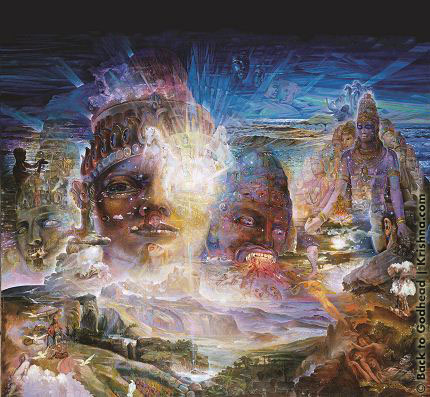
Some scholars point to Chapter 11 of the Gita as a kind of Apocalypse, for it is here that Krishna displays his ability to devour the universe in an explosion of nightmarish imagery and atomic fire. Still, nowhere does Krishna say that this is how things must be. The Gita is overall an optimistic work that resides at the bright end of the literary spectrum.

Krishna reveals his unpleasant side

Guided by the Gita’s teachings, members of the bhakti community benefit from resources that writers and peacekeepers might want to consider when envisioning potential futures for humanity: (1) knowledge of the fundamental oneness of life on its substratum of consciousness, and (2) faith in a beneficent divinity capable of resuscitating even the most devastated of post-Apocalypse scenarios. The two tools—knowledge and faith—go together. Knowledge without faith remains abstract and does not assure change in behavior; and faith without knowledge remains blocked on the level of sentiment and may even fuel fanaticism. 

Unlike the wildly popular Left Behind series, which also depicts an end-of-time scenario, the Gita does not posit any exclusive clubs for those who will be saved. A simple acknowledgment that the sanctity of things precedes selfish interests suffices for a multitude of unseen resources to kick in. Amazing, really, what even a hint of humility can do to set humanity back on track.

The Gita may lack some of the page-turner qualities of the current spate of Apocalypse literature (for that you’ll need to revert to the larger work Mahabharata of which Gita is but a handful of chapters). Still, for an ending that leaves readers feeling hopeful and a bit more cheerful, Gita deserves the Pulitzer.

Books mentioned in this article:

  • Oryx & Crake by Margaret Atwood
  • The Road by Cormac McCarthy
  • Brave New World by Aldous Huxley
  • 1984 by George Orwell
  • Left Behind series by Tim LaHaye and Jerry B. Jenkins
  • Bhagavata Gita As It Is commentary by A.C. Bhaktivedanta Swami
  • Mahabharata retelling by William Buck

The article contains affiliate links. Gita Wisdom may receive a small commission from the purchases through these links.

Filed Under: Art Tagged With: end of times

May 9, 2020 by Gita Wisdom

The Middle Path of Yoga [BG 6.16]

Recorded on May 5, 2020

-Yoga is self-evaluation of the highest order
-Don’t be a fanatic – take the middle path
-Sincere effort attracts a teacher
-Regulate your behavior
-Making the distinction between what we want and what others expect
-The Gita gives you more to discover each time you go back to it

Stream

Subscribe

[iTunes] [Stitcher] [Hipcast] [Spotify]


Homework

For our next class please read [BG 6.17].
 

Verse

[BG 6.16]
nāty-aśnatas tu yogo ’sti / na caikāntam anaśnataḥ
na cāti-svapna-śīlasya / jāgrato naiva cārjuna

There is no possibility of one’s becoming a yogī, O Arjuna, if one eats too much or eats too little, sleeps too much or does not sleep enough.

Mentioned in this podcast

Book: Bhagavad Gita As It Is
Quote: “…the moment one definitely commits oneself, then Providence moves too. All sorts of things occur to help one that would never otherwise have occurred. A whole stream of events issues from the decision, raising in one’s favour all manner of unforeseen incidents and meetings and material assistance, which no man could have dreamt would come his way.” — W.H. Murray, The Scottish Himalayan Expedition

Transcription

Joshua 0:00
Welcome to the next segment of our weekly discussion groups. This is the continuation of a weekly series of discussions that began in 2006 at Jivamukti Yoga on Broadway and 13th Street. So this is 14 years that we are doing this. Some of you were three years old when we started our discussions and you’ve grown up very nicely. It’s nice to see all grown up. Can you imagine 14 years? So greetings to old friends, to new friends. Welcome one and all.

And also I want to announce to you that I’m thrilled to be sharing the helm of these weekly sessions with my dear friend and God brother Yadunath. So thank you Yadunath for agreeing to share the embarrassment with me when things go south and to fill in when I can’t figure out what to say anymore. So it’s really great having you there.

This is Bhagavad Gita, chapter six, verse 16, of the Bhagavad Gita. We’ll talk about the context in a moment. nāty-aśnatas tu yogo ’sti I’ll do that again. nāty-aśnatas tu yogo ’sti Want to try that with me? You’re welcome to. nāty-aśnatas tu yogo ’sti The second line is na caikāntam anaśnataḥ na caikāntam anaśnataḥ. The third line is na cāti-svapna-śīlasya na cāti-svapna-śīlasya. And the fourth line reads jāgrato naiva cārjuna. jāgrato naiva cārjuna.

So the translation of this 16th verse of chapter six Bhagavad Gita, there is no possibility of one’s becoming a yogi Arjuna if one eats too much, or eats too little sleeps too much, or does not sleep enough no possibility of one’s becoming a yogi or do you know if one eats too much or too little sleeps too much? That does not sleep enough?

Yadunath, you and I started to talk about this earlier today. And the discussion that we started there was, are we to take this on face value? Is it really just about “Hey, watch your diet and you know, get enough rest?” What’s going on here? There’s always a bigger context. When you’re talking about Bhagavad Gita, things are happening on ten different levels all the time.

I don’t know if you’ve had a chance to think about this. But-

Yadunath 3:00
Yeah, things are happening on multiple levels at the same time, including the surface level.

Joshua 3:07
Right.

Yadunath 3:08
There’s a lot of depth-

Joshua 3:08
It’s also about food.

Yadunath 3:10
Yeah, that’s the beauty of the Gita, which is why you can keep going back to it year after year after year, getting deeper and deeper and deeper into it. There’s always more to discover.

Joshua 3:21
Alright, so on that obvious level, Arjuna is being given some very practical advice, right? If you eat too much, you’re gonna get sick. If you don’t eat enough, you’re not gonna have any strength to do anything. If you sleep too little you’re going to be tired all day and if you sleep too much, you’re gonna be drowsy. Alright, so that seems to be pretty practical.

Always remember context, context, context, context. We’re on the battlefield. Arjuna did not want to fight. Krishna is telling him, “This is your dharma1) religious principles, 2) righteous behavior. This is your duty. But if you’re insisting on not fighting, let’s take a look at your arguments. Let’s go through this one by one”.

And Arjuna at the end of the first chapter had given about a dozen different reasons why one should not fight: the scripture say do no harm to people, if I do this I can’t enjoy it even if I win, and so on and so on and so forth. And his conclusion was better for me to become a yogi and go off on my own and leave this battlefield, just you know, leave the stress and anxiety behind and just be peaceful.

Alright, so in the sixth chapter- my take on this is Krishna’s kind of like jabbing an elbow a little bit into Arjuna’s ribs and saying, okay, wise guy, you want to be a yogi? Here’s what you got to do. And then in the first verses of this chapter, he says, “Give up all company, go out to the middle of the forest, way up in the mountains, put down a rug of deer skin on top of kusa grass, stop breathing, stop eating, stop sleeping, don’t have contact with anybody, merge your outcoming breath with your incoming breath… And Arjuna starts getting a little freaked out he says I just can’t do this. We’re at a point here where Krishna is still kind of sticking it to him saying this is how you got to do it. This is how you have to do it. Arjuna will say I can’t. Enough. Another few verses, he says it’s like trying to control the wind, what you’re describing here.

Yadunath 5:26
It’s like a lockdown in quarantine on steroids.

Joshua 5:30
If you will. Try going to the woods and having no contact with anybody except wild animals. You are exposed there to whatever stresses may come living in the wild. And there’s a way to do that there are shastras that describe how to live successfully in seclusion, in the woods. There are scriptures for that. But it involves finding your own food. It involves learning how to live under very extreme conditions.

Krishna’s point to Arjuna is, if this is really what you want to do fine, but look at what the consequences are going to be. These people, these enemies on the other side of the battlefield are still going to be there. We might identify them as terrorists in today’s language. They were people who had no compunction whatsoever, killing whoever stood in the way of their taking over the kingdom. They had to be stopped. And Krishna’s point to Arjuna is if you don’t do it, who’s going to do it? That’s a little bit deeper than just watch your diet. The point he’s making is who’s going to do this if you don’t do it?

And I don’t know about you guys, but I’ve been confronting some of that myself lately. I’m coming up on 70 next month, and I don’t think it’s the end of the road. I still got a few miles to go. But I must admit, I’ve been feeling the energy waning a little bit and asking myself, how aggressive should I be about doing stuff still? You know, I was raised by a mom who was a real go getter. She was in corporate life. And she always taught me to look back at the end of the day and say, I did this, and I did this, and I did this and this and this and this, make your life productive. Right? Materially productive. So I’m having to ask myself, can I afford now to step back? Or do I need to have some of that go-do-something energy for as long as I possibly can? And I admit, I don’t always know the answer. Sometimes I just want to go and read and maybe be like Arjuna and just retreat a little bit. But there seems like there’s so much to do in the world, and I don’t know, I don’t know what I should do. Does life begin after 70? Do we still set our sights on doing great things? I mean, Arjuna wanted to stop. Krishna said no, you can’t stop. You have to keep going. Is anybody out there on this Zoom discussion confronting feelings like that? I mean, maybe having a break from the everyday world has given you a chance to think a little bit about what you want to do with yourself now. Does that ring any bells for anybody? Show me a five, if any of you have had those moments of Yeah, what do I do now? What’s next for me in life? I got a whole bunch of fives. Okay, well, anybody want to share what your conclusions have been? What’s come out for you and that meditation?

Student 8:39
For me, um, I’m sorry, I can’t relate to being 70. But my, the one thing I was really supposed to do is like study because I’m a student. And then my school kind of shut down. And I was kind of caught between this, do I just do the work, but not learn or do I actually try my best to still learn like when I’m learning class. It’s a conflict because- you can see my room’s a little distracting. I can’t go to the library. So it was like, what do I do? And how do I adjust to this new life? And it sucked for a while. You just got to find out what’s right and kind of find what do I actually want to do? And what am being expected to do?

Joshua 9:24
Mm hmm. Okay, that’s a good distinction and in between what other people expect of us and what we expect of ourselves. I can identify with that. Sometimes I think am I trying too hard to do what other people expect of me? That’s a good point. Yeah. Thank you for that.

Quick question. “In Winthrop Sargent”, when Winthrop Sargent has an edition of the Bhagavad Gita that goes back 100 years or so, “the verse is 16, not 17 does it matter?” Different editions of the Gita have numbered verses in slightly different ways, sometimes more than one verse is grouped together. For example, in the addition we’re using by Prabhupada, Bhagavad Gita As It Is, sometimes you’ll see two or three, I think in some instances, even four verses grouped together for the sake of clarity for getting the entire idea out. So it doesn’t really. Remember this isn’t even a book. This is a discussion, this is a dialogue between two people. It was sages and scholars in later years, who took this conversation and divided it into 18 chapters. Originally, it wasn’t a chapter book. It was a live, very energetic conversation on a battlefield.

Student 10:44
So is there advice like just stop, that’s what yoga is, just self regulation and discipline? Stop, look back, [inaudbile] your options and live a disciplined life? Evaluate yourself?

Joshua 11:03
Well, certainly, yes, yoga is self evaluation of the highest order. That’s a nice way of describing. It’s therapy its self-evaluation, it’s introspection, it’s a lot of things. The the risk is trying to do it on your own. I mean that’s, for me, that’s the value of having these gatherings here is not to hear myself yakking up for a half hour. So first of all, I asked Yadunath to come on so that that won’t happen. But secondly, it’s because I think our best realizations, our best introspection, comes when we can do that with people we trust. It’s really all about trust. If you have a group of people whom you can open your heart to, now you can have a meaningful dialogue.

Yadunath 11:50
I think, also, Krishna is talking about the value of leading a regulated life. You know, it’s interesting to say, don’t eat too much, which is sort of the obvious thing. But also don’t eat too little. Don’t sleep too much, the obvious thing, but also don’t sleep too little. And it makes me think of when we’re gluttonous, we want too much of it. But then the other side of that is maybe like, I want to live a spiritual life. But I also kind of get puffed up about it and proud about it. So, “no, no, no, I shouldn’t, just give me some rice. That’s fine. I’ll sleep just a few hours a day”. And then that can be a sense of pride and that can also bring us down. I used to have very long hair, like, down past my little nipples, and that was like a badge for me like letting my freak flag fly, right? But then I shaved my head. Right when I first started hanging out with devotees or not right at first, but eventually, and so I did a shaved head with the sikha, a little tuft of hair in the back of the head. But that was a version of having long hair for me, because it was still unconventional. So I had that look going. So the regulation for me, the most difficult thing for me was not the really long hair or the shaved head, it was like the normal thing in between, you know, and for me, that’s the challenge of how to get through like, not look for that distinction of being different.

Joshua 13:24
Hmm. That’s fascinating. I think you’ve put your finger on a subtle message in Krishna’s instruction to Arjuna in this verse. He’s saying basically don’t be a fanatic. Don’t be a fanatic. Don’t think that you have to just, you know, slaughter like a madman or leave the battlefield all together. There’s a way to conduct yourself here. That is the middle road. There’s a middle path here. The middle path for a warrior of course is to fight bravely and sometimes it’s to the death, but with compassion. Now that may seem like a contradiction. They may seem counterintuitive, there is a way to fight with compassion. There’s a way to kill according to the Arthashastra. If you have to bring someone down because they’re an evildoer, there’s a way to do that by causing the least amount of pain and suffering possible. I’m right in the middle of preparing a holocaust book and it was diametrically the opposite. It was like kill someone by causing them the most amount of pain possible before they die. So the Vedic ideal would be no, there’s a way even to fight. There’s a way to do everything spiritually, and it usually has to do with that middle path there. Yeah.

Being normal that’s a big accolade when once you’ve entered devotee life. I think it’s the highest compliment anyone ever paid me, “You’re like, normal.” It was like that was a good day for me.

Next week’s is an extension of the idea from this week’s class about being regulated and habits. So we can talk about what regulated means. There’s a time and place for breaking out of regulation as well. And we can talk about that. Any any thoughts, questions, ideas, comments?

Yadunath 15:34
I’d like to point out that Mike sent on the chat here, that Prabhupada was very active in later life. And it’s a really good point, because you were talking earlier about, am I supposed to- can I sit back now, and it seems like there are two different, potentially two different kinds of activity, you know, material activity and spiritual activity. Of course, you can bring the spiritual to your material life. And that’s what we’re trying to do overall. At some point, when your material needs are all taken care of, and you still got some time left, and like you said, you know, you still got the energy, but you feel it maybe receding a little bit. In any case, whatever we do have, at that time, direct it toward our spiritual lives. Prbhupada set out just about 70 years old, you know, going cross seas to start a worldwide movement, you know. So, he wasn’t sitting back, and it’s a really challenging thing. I mean, you’re that age now. And I’m thinking about getting there soon enough. And, wow, I don’t think I’d be wanting to travel and start a movement in a place I’ve never been to before.

Joshua 16:53
Prabhupada very kindly accepted me as a disciple in January of 1970. So I’ve been doing this for more than 50 years. To this day, I do not know how he got on that boat. I don’t know how he did it. I don’t know how or why he would leave Vrindavan, this beautiful, spiritual home of Krishna and the eternal world, to come to the Lower East Side of New York City, and be exposed to all of that madness, all that craziness. I don’t know how he did that. I think there’s only one explanation. That’s love. He said once I love Govinda and therefore I love all of you. I mean, it’s through that love of God that he was experiencing discomfort seeing us, you and you and you and you and you and me uncomfortable in our lives, and he wanted to help do something about that. Who does that? Who leaves at age 70? You’re right. Yeah, it’s a good reminder, we can all do more than we think we can. So that’s a good reminder.

Yadunath 18:05
We have a determination, you know, the sincere desire and the determination then Krishna gives us what we need.

Joshua 18:13
Yeah, Sir Edmund Hillary, who I believe was the first person to climb Mount Everest, once is credited with having said, when you make a commitment to a very difficult task, it is after you have made that commitment, that resources come to your aid that you could never have imagined. The universe is filled with energies, filled with all kinds of resources, unless you open the door unless you show that you’re going to do something, all of those resources have no place to go to. So it’s up to us to take the first step. A good reminder. Thank you. I knew there was a reason to have you on this call this evening.

Yadunath 18:58
I thought it was just because I’m pretty.

Joshua 19:00
Well, you are that, too. You may not be as pretty as Tracy with that parakeet on her head.

Yadunath 19:07
Well, nothing is in that category.

Joshua 19:10
Anyway, thank you all. I’m glad we’ve decided on a start time. I will see you next Tuesday at 6:30.

Student 19:19
Josh, can I ask you a question before I go?

Joshua 19:21
Sure, Adam. What’s up?

Student 19:23
So, you found your teacher at a young age, right? How did you? How did you go about finding a teacher like that?

Joshua 19:34
Oh, that was infinite grace. He found me. I’m not even sure I was looking for a teacher, quite honestly. I think he found me.

Student 19:48
Okay, because I’ve been doing a lot of reading and as you said, it’s kind of difficult to do this alone and all these great spiritual teachers have had other great spiritual teachers and, I don’t want to say I’m like searching for that, but it’s just, it’s interested me. How-

Joshua 20:06
Here’s what’s wonderful about this spiritual journey. You don’t have to worry about that. If you continue sincerely, and this is reiterated many, many times throughout the sacred texts, if your effort is sincere, the teacher will come to you.

You just have that desire in your heart to do well on your spiritual path. That’s the whole- that’s that quote from Mr. Edmund Hillary, resources will come to your aid that you could never have imagined.

Student 20:45
Thank you very much.

Joshua 20:46
You’ll see. It’s there. Thank you for your wholehearted commitment. Please join me in the Vaishnava Pranama.

vancha-kalpatarubhyas ca kripa-sindhubhya eva ca
patitanam pavanebhyo vaishnavebhyo namo namah

Thank you. It’s nice to have your company. Hare Krishna. Good night everybody.

Show more
Show less

See What We’re Up To

[Instagram] [Facebook Page] [Facebook Discussion Group] [Event Calendar]

Filed Under: Podcast

Primary Sidebar

Under the guidance of His Divine Grace A.C. Bhaktivedanta Swami Prabhupada (1896-1977)
Founder - Acharya of the International Society for Krishna Consciousness.
Gita Wisdom is a trademark of Stories To Remember, a New York cultural organization.