
“Know truly: that which pervades the body does not die. Nothing can destroy the imperishable soul.”
Bhagavad Gita 2.17.2017
 The Nike of Samothrace, ancient Greece’s goddess of victory, is celebrated in this renowned sculpture known as “Winged Victory.” She embodies not only ideal beauty but action and triumph, a fusion of external participation and internal stillness-an apt metaphor for verse 2.17 of the Bhagavad Gita.
The sacred Gita informs us that as eternal souls we, too, have the potential for victorious action in the world. Life’s traumas cannot hold us down. They do not own us. We are their witness, not their victim. The atma or imperishable soul is untouched by external stress. We succumb to stress when we mistakenly identify with the empiric world. The Gita offers this reassurance: you, the immortal soul energizing the physical body and subtle mind, share Krishna’s qualities of eternity, self-awareness, and bliss. Like sparks from a fire, we possess the qualities of the fire. You are a beautiful, empowered being, a spark of God.
Be like Winged Victory. Cultivate knowledge of your inner divinity through healthy habits, good company, and daily meditation. Become an agent of change, triumphant yet calm and still. Here’s one simple way: each morning for five minutes, chant the sacred mantra Hare Krishna, Hare Krishna, Krishna Krishna, Hare Hare, Hare Rama, Hare Rama, Rama Rama, Hare Hare. Experience divinity for yourself.
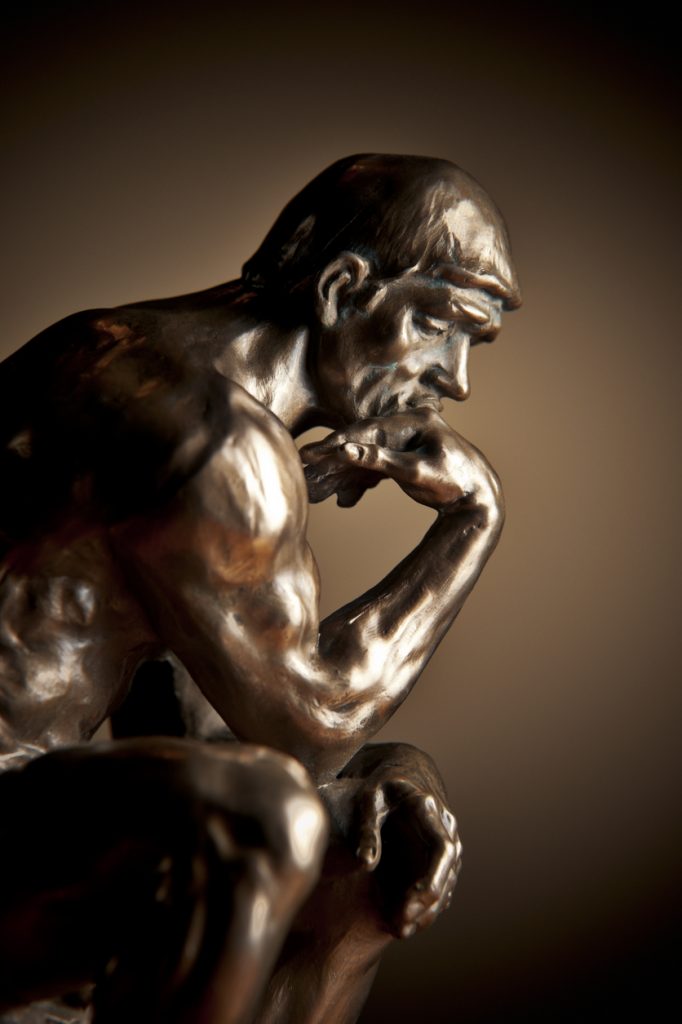 “The Thinker” by August Rodin depicts a man tormented by mental uncertainty. Completed in 1902, the six-foot-tall sculpture portrays Italian poet Dante Alighieri in front of the gates of hell, pondering his own poem “The Divine Comedy.” Dante’s poem proposes that we create our own heaven and hell, and as we observe the thinker’s intense deliberation we feel his torment. Will humanity cultivate an open mind about the greater mystery of life, or are we forever doomed to the hell of our prejudices and fears?
 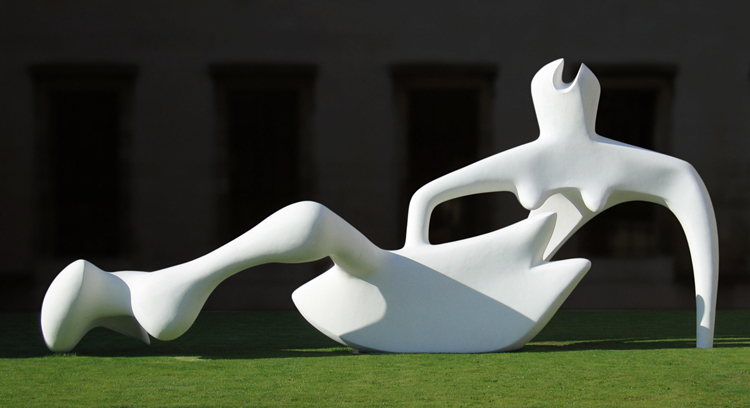 Sculptor Henry Moore (1898-1986) collected rocks and shells and studied their holes and hollow spaces, searching for what he called nature’s invisible “principles of form and rhythm.” His series of reclining figures (like the one above from 1951) is as much about the mystery of what cannot be see — the spaces between things — as about what the eye perceives.